

Cystic fibrosis isn’t just a lung disease. It’s a full-body condition born from a single broken gene, and for decades, it meant a shortened life filled with daily battles just to breathe. Today, that story is changing - not because of luck, but because of science that finally targets the root cause, not just the symptoms.
What Cystic Fibrosis Really Does to Your Body
Cystic fibrosis (CF) is caused by mutations in the CFTR gene, which controls how salt and water move in and out of cells. When this gene doesn’t work right, mucus becomes thick and sticky instead of thin and slippery. That mucus clogs the lungs, pancreas, liver, and reproductive system. In the lungs, it traps bacteria, leading to constant infections and scarring. In the pancreas, it blocks digestive enzymes, so food doesn’t break down properly. Many people with CF need to take enzyme capsules with every meal - sometimes 12 at a time.
One of the clearest signs of CF is salty sweat. That’s why the sweat chloride test is still the gold standard for diagnosis. Babies are now screened for CF at birth in all U.S. states, catching it before symptoms even appear. The most common mutation, F508del, affects about 70% of people with CF worldwide. But there are over 2,000 known mutations, and not all respond the same way to treatment.
Why CF Is Different From Other Lung Diseases
People often confuse CF with asthma or chronic bronchitis. But those conditions don’t come from a genetic flaw in how your cells handle salt and water. Primary Ciliary Dyskinesia (PCD), another genetic lung disease, affects the tiny hair-like structures (cilia) that sweep mucus out of the airways. In CF, the cilia work fine - it’s the mucus itself that’s too thick to move. That’s why treatments for asthma or PCD don’t help CF patients the same way.
CF also hits harder because it doesn’t stay in the lungs. About 85% of people with CF have pancreatic insufficiency. Nearly all men with CF are infertile because they’re born without a key reproductive duct. Liver damage happens in about 30% of cases. This multi-system impact makes CF one of the most complex genetic diseases we treat.
The Breakthrough: CFTR Modulators
Before 2012, treatment was all about managing damage: antibiotics for infections, chest physiotherapy to clear mucus, high-calorie diets to fight weight loss. Life expectancy hovered around 30 years. Then came ivacaftor (Kalydeco), the first drug that actually fixed the broken CFTR protein. It worked for people with the G551D mutation - just 4% of the CF population. But it proved the idea: you could fix the root problem.
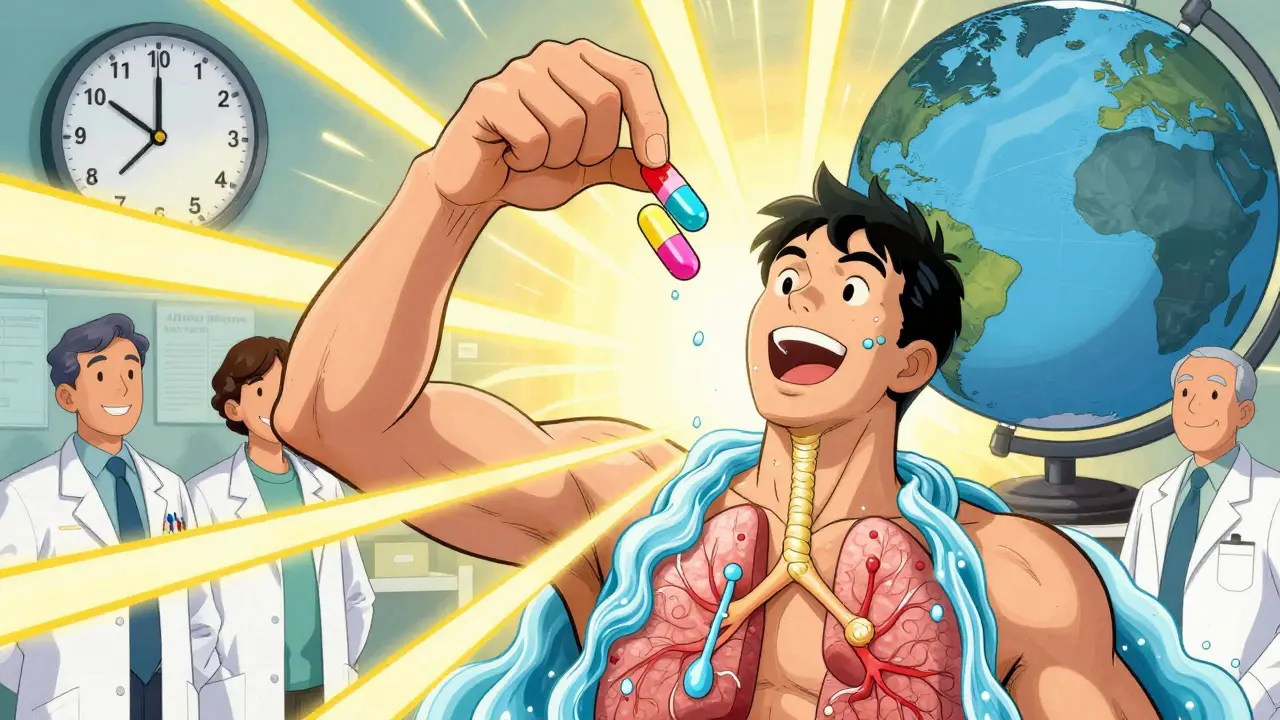
Then came triple-combination therapy: elexacaftor/tezacaftor/ivacaftor, known as Trikafta. Approved in 2019, it works for about 90% of people with CF, including those with two copies of F508del. Clinical trials showed a 13.8% jump in lung function - that’s more than most asthma drugs can achieve. Pulmonary exacerbations dropped by 63%. People started gaining weight without changing their diet. Many cut their daily airway clearance time from 90 minutes to under 20.
By 2023, 90% of people with CF in the U.S. had access to at least one modulator. The median predicted survival jumped to 50.9 years - up from just 14 in 1960. For the first time, most people with CF are adults.
The Dark Side of Progress
These drugs aren’t perfect. They cost about $300,000 a year in the U.S. Even with insurance, many families pay $1,200 a month out of pocket. Globally, only 35% of people with CF have access to modulators. In low-income countries, the number is under 10%. That means the gap between those who live and those who don’t is now a matter of geography and money, not biology.
Side effects are real too. About 3.2% of patients develop liver enzyme spikes severe enough to stop treatment. Some report headaches, dizziness, or rashes. A small number develop cataracts. Long-term data is still being collected - these drugs haven’t been around long enough to know what happens after 20 or 30 years of use.
And then there’s the 10% left behind. People with rare mutations - like Class I nonsense mutations - don’t benefit from current modulators. For them, treatment still means hours of daily therapies, frequent hospital stays, and a life expectancy closer to the old numbers. One documented case in Europe followed a 34-year-old with a rare mutation who developed worsening lung damage despite aggressive care. No modulator helped. That’s the next frontier.
What’s Next in CF Treatment
Researchers aren’t stopping. The Cystic Fibrosis Foundation has poured over $750 million into CF research since 1989. Today, they’re funding 15 active clinical trials. One targets nonsense mutations with mRNA therapy - a technique that teaches cells to skip over the broken part of the gene. Another uses CRISPR gene editing to fix the CFTR gene directly in lung cells. There are also new inhaled antibiotics designed to kill stubborn Pseudomonas bacteria that survive even the strongest drugs.
Trikafta was approved for kids as young as 2 in early 2023. That means more children will grow up with near-normal lung function. But the real goal is a cure - not just better management. The Foundation’s ‘Path to a Cure’ initiative has pledged $100 million to tackle the 10% who don’t benefit from current drugs. That’s where the next breakthrough will come.

Living With CF Today
If you’re diagnosed with CF today, your daily routine looks very different than it did 10 years ago. For those on modulators, it’s often just one or two pills in the morning and evening. Airway clearance is shorter. Infections are rarer. You can eat normally, gain weight, and maybe even run a 5K.
But it’s still a chronic disease. You still need regular checkups. You still need to monitor your nutrition. You still need to avoid germs. And if you’re not on a modulator, your day might still include six different inhaled medications, 12 enzyme capsules, two hours of chest physiotherapy, and oxygen at night.
Support networks matter more than ever. The Cystic Fibrosis Foundation runs 260 accredited care centers in the U.S. and offers 24/7 clinical advice. Online communities like CF Buddy Connect have over 12,500 active users sharing tips, struggles, and wins. The annual International CF Conference brings together doctors, researchers, and patients - a rare space where science and lived experience meet.
Who Benefits Most - And Who’s Left Out
Modulators are a miracle, but they’re not a universal solution. They work best for people with specific mutations, and only if they can afford them. In the U.S., 85% of eligible patients are on modulators. In the EU, it’s 45%. In many parts of Africa, Asia, and Latin America, it’s under 5%.
The pharmaceutical market for CF is now worth $6.2 billion, and Vertex Pharmaceuticals controls 95% of it. That’s because the Cystic Fibrosis Foundation took a bold risk in 2000 - investing $150 million in a small biotech company (Aurora Biosciences) that was working on CFTR modulators. They didn’t just fund research; they helped build the drug pipeline from scratch. That’s the power of patient-driven science.
But without global access, these advances deepen inequality. WHO reports that 75% of CF deaths now happen in countries without modulator access. The disease is no longer just genetic - it’s economic.
What You Need to Know Right Now
If you or someone you know has CF:
- Get genetic testing to identify your specific CFTR mutations - that determines what treatments you qualify for.
- Work with a CF care center. These aren’t just hospitals - they’re specialized teams trained in CF’s unique needs.
- Ask about financial aid. The Cystic Fibrosis Foundation and drug manufacturers offer co-pay assistance and patient support programs.
- Stay informed. New therapies are coming fast. What’s true today may change in 12 months.
- Don’t wait. Even if you’re not eligible for modulators now, new options may be approved soon.
Cystic fibrosis is no longer a death sentence. But it’s still not a solved problem. The science is here. The tools exist. What’s missing is fair access - for everyone, everywhere.
Is cystic fibrosis curable?
No, cystic fibrosis is not yet curable. But for about 90% of people with CF, new drugs called CFTR modulators can fix the underlying protein defect, turning a life-limiting disease into a manageable chronic condition. Survival rates have doubled in the last 30 years. Research is now focused on gene editing and mRNA therapies that could one day offer a true cure, especially for the 10% who don’t benefit from current treatments.
Can you outgrow cystic fibrosis?
No, you cannot outgrow cystic fibrosis. It’s a genetic condition you’re born with, and the faulty CFTR gene stays with you for life. But with modern treatments - especially CFTR modulators - many people live into their 50s and beyond. The disease doesn’t disappear, but its impact can be dramatically reduced. Today, more than half of all people with CF are adults.
How do CFTR modulators work?
CFTR modulators are drugs that fix the defective CFTR protein. Some help the protein fold correctly (correctors like tezacaftor), others help it open and let chloride through (potentiators like ivacaftor). Triple-combination therapies like Trikafta do both at once. They don’t change your DNA - they fix the protein your body already makes. This allows salt and water to move normally, thinning mucus and reducing infections.
What’s the average life expectancy for someone with CF today?
As of 2022, the median predicted survival for someone with CF is 50.9 years. That’s up from just 14 years in 1960. For children born today with CF who have access to modulators, many are expected to live into their 60s or beyond. Survival depends heavily on mutation type, access to treatment, and how early therapy begins.
Are CFTR modulators available worldwide?
No. While 85% of eligible patients in the U.S. have access to modulators, only 45% do in the European Union, and less than 10% in low- and middle-income countries. These drugs cost about $300,000 per year per person. Without government subsidies or patient assistance programs, most people outside wealthy nations cannot afford them. This creates a global health disparity where survival now depends on where you live.
Can someone with CF have children?
Most men with CF are infertile due to missing or blocked vas deferens, but they can still father children using assisted reproductive technologies like IVF with sperm extraction. Women with CF can become pregnant, though pregnancy carries higher risks due to lung function decline and nutritional demands. With good health and medical support, many women with CF have healthy pregnancies. Genetic counseling is strongly recommended before planning a family.
Do CFTR modulators have side effects?
Yes. Common side effects include headache, nausea, and insomnia. More serious ones include elevated liver enzymes (seen in about 3.2% of patients, sometimes requiring treatment stoppage) and cataracts in rare cases. Some people report weight gain, which is often a positive sign of improved nutrition. Regular blood tests are required to monitor liver and kidney function. Most side effects are manageable and less severe than the damage caused by untreated CF.
What happens if you miss a dose of CFTR modulators?
Missing one or two doses occasionally won’t cause immediate harm, but these drugs work best when taken consistently. CFTR modulators keep the corrected protein active - if you stop taking them, the protein degrades over days, and thick mucus begins to return. Skipping doses regularly can lead to increased infections, lung function decline, and more hospital visits. Adherence is critical - even small lapses can undo progress.




Raushan Richardson
Just saw my cousin start Trikafta last month - she went from needing oxygen at night to hiking 5 miles without stopping. I cried. Not because it’s miraculous (though it is) but because she finally gets to just *be*.
Kylie Robson
Let’s be real - Trikafta’s efficacy is only statistically significant because the trials excluded patients with comorbidities. The real-world data? Messy. And don’t get me started on the pharmacokinetic variability across CFTR genotypes. This isn’t a cure. It’s a band-aid with a $300K price tag.
Anna Weitz
Why do we keep pretending this is medicine when it’s just corporate profit dressed in lab coats? The 10% left behind? They’re not an afterthought - they’re the reason this whole system is broken
John Barron
Anyone else notice how the CF Foundation’s ‘Path to a Cure’ campaign never mentions that Vertex owns the patents? They’re not funding a cure - they’re funding a subscription model. 🤡
Caitlin Foster
Wait wait wait - so you’re telling me… people with CF can now… RUN? Like… actual running? Like… without wheezing? I’m literally screaming right now!! 😭🎉👏
Gerald Tardif
My sister’s been on modulators for three years. She’s got a job, a dog, and a boyfriend who doesn’t flinch when she coughs. That’s not progress - that’s dignity. And it’s worth fighting for.
Paula Alencar
Let us not forget the profound human cost of this inequity. A child in rural India, born with the same mutation as a child in Boston, faces a different future - not because of biology, but because of borders. This is not a medical failure. It is a moral catastrophe.
Liz MENDOZA
I work with CF families every day. The relief on a parent’s face when they hear their kid can take one pill instead of twelve? That’s the real breakthrough. Don’t let the cost talk drown out the quiet joy in these homes.
Nikki Thames
And yet, we still let pharmaceutical companies dictate who lives and who dies. We have the science. We have the money. What we lack is the collective will to say: no one should be priced out of breathing.
Alex Lopez
As a bioethicist who’s studied drug pricing for two decades - this isn’t innovation. It’s exploitation with a clinical trial. The fact that we celebrate Trikafta as a triumph while 90% of the global CF population can’t access it? That’s the real tragedy. 🤖💸
Satyakki Bhattacharjee
Money decides life and death now? This is not science. This is the end of humanity. God gave us lungs. Man gave us prices. Who are we becoming?
Andrew Gurung
Oh please. You think this is bad? Wait till you see the next-gen gene editors. CRISPR babies are coming. And guess who’s gonna get them? The rich. The rest of you? Still coughing into your $1200/month pill bottles. 😇
Will Neitzer
While the ethical concerns are valid, we must acknowledge the unprecedented momentum in CF research. The Cystic Fibrosis Foundation’s venture model - patient-driven, profit-reinvested - created a pipeline that Big Pharma refused to touch. This isn’t perfect, but it’s the most effective rare-disease model we’ve ever had.
Janice Holmes
Let’s not romanticize the ‘new normal.’ Trikafta doesn’t erase fibrosis - it just moves the goalposts. Now we’re facing novel complications: drug-induced hepatotoxicity, accelerated cataract formation, and the psychological toll of being a ‘miracle patient’ in a system that still treats you as a liability. This isn’t victory - it’s recalibration.