
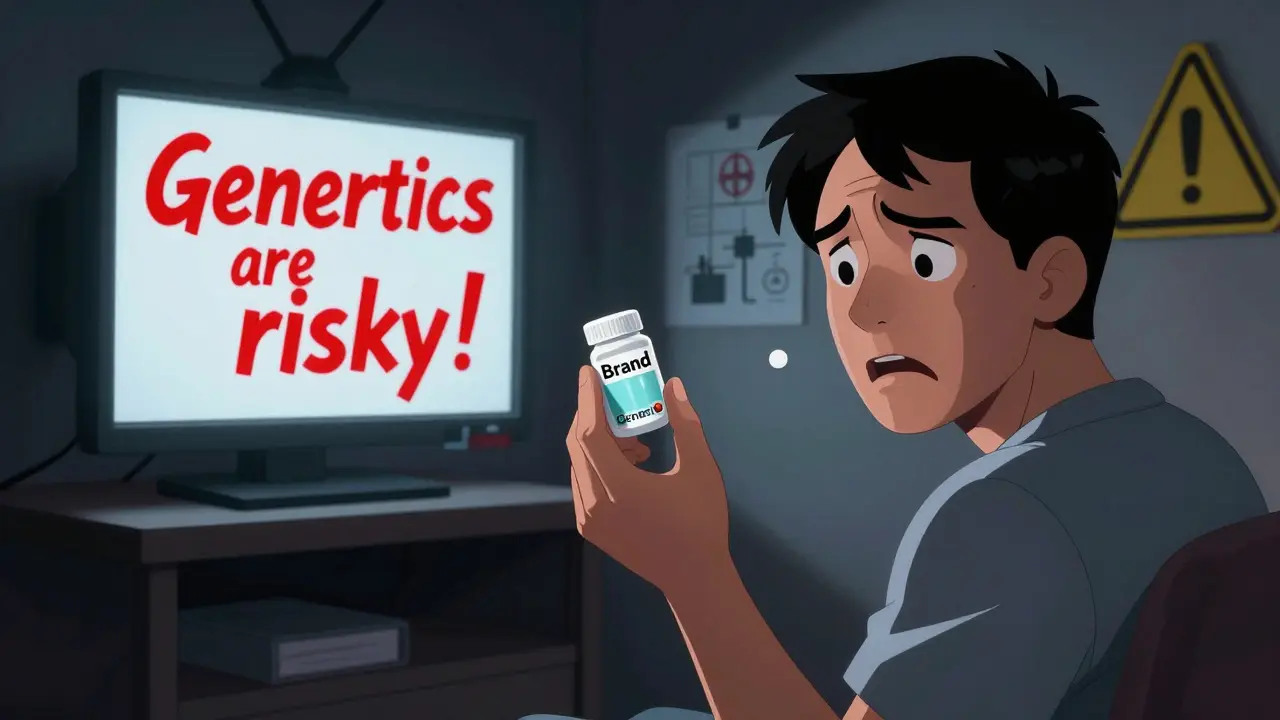
When you pick up a generic pill at the pharmacy, you expect it to work just like the brand-name version. That’s the whole point. But what if the ad you saw on TV told you otherwise? What if it whispered that generics are less effective, less safe, or even risky - all while pushing you toward the pricier option? That’s not just misleading. It’s illegal. And in 2026, the consequences for getting it wrong are sharper than ever.
What Counts as False Advertising in Generic Drugs?
False advertising in generic pharmaceuticals isn’t about lying outright. It’s about twisting the truth. The FDA requires generics to prove they’re bioequivalent to the brand-name drug - meaning they deliver the same amount of active ingredient into your bloodstream at the same rate. That’s not a suggestion. It’s a hard standard: 80% to 125% of the reference drug’s pharmacokinetic profile. If an ad says a generic is "just as good," but hides the fact that it hasn’t been tested for a specific condition, or implies it’s inferior without evidence, that’s a violation.
Here’s what crosses the line:
- Using "FDA Approved" for a product that only has "FDA Clearance" - a common trick that confuses patients.
- Suggesting a generic is less effective than the brand without head-to-head clinical trials.
- Showing visuals that mimic the brand-name pill’s shape, color, or logo to create confusion.
- Claiming "cost savings" without being able to prove the exact dollar amount - the FTC requires hard data.
- Running ads that say "health alert" or "dangerous" for generics, especially when no FDA warning exists.
These aren’t gray areas anymore. The FDA’s September 2025 memorandum made it clear: deceptive ads that push expensive drugs over generics are a public health threat. And they’re now going after them with unprecedented force.
The Laws That Keep Generic Ads Honest
Three big laws are in play here. First, the Federal Food, Drug, and Cosmetic Act (FD&C Act) gives the FDA authority over drug labeling and advertising. If your ad misrepresents safety or effectiveness, the FDA can issue a warning letter, demand a correction, or even block the campaign.
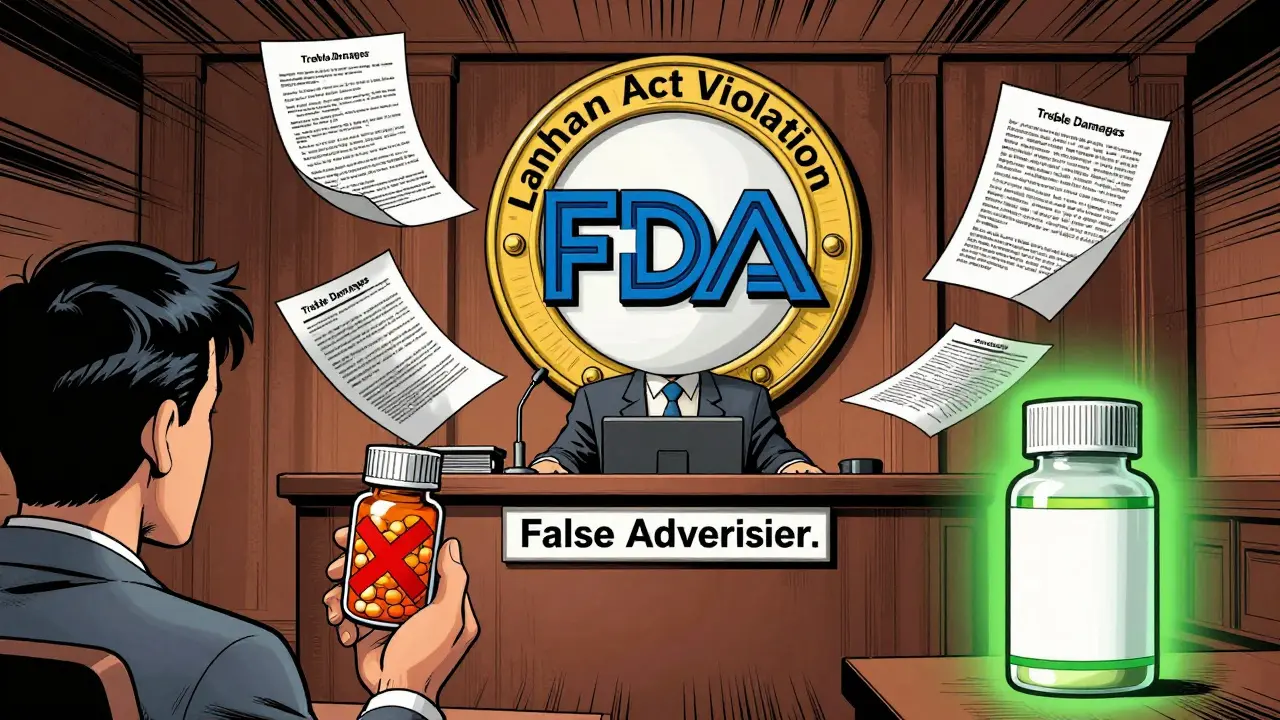
Second, the Lanham Act lets competitors sue each other. That’s right - if your rival’s ad makes your generic look bad, they can take you to court. In 2025 alone, at least seven major generic manufacturers faced Lanham Act lawsuits over misleading claims about bioequivalence. One case resulted in a $42 million judgment after an ad implied a generic thyroid drug was unsafe - even though the FDA had confirmed its equivalence.
Third, every state has its own consumer protection law. New York’s General Business Law § 349 lets courts award treble damages - three times the actual harm - plus up to $1,000 per violation. California’s Unfair Competition Law is even stricter. And Florida? It bans ads from using government logos or phrases like "health alert" if they’re meant to scare people away from generics.
There’s no escaping this patchwork. A global company can’t run one campaign across the U.S. and call it good. What flies in Texas might get you fined in New York.
How the FDA Is Cracking Down in 2026
In September 2025, the FDA didn’t just issue guidance - it launched a full-scale enforcement push. The Department of Health and Human Services was ordered to stop ads that "inappropriately intervene in the physician-patient relationship" and "advantage expensive drugs over cheaper generics." That’s not a footnote. It’s the new rulebook.
Here’s what changed:
- Over 100 cease-and-desist letters were sent to companies running misleading ads.
- The "adequate provision" loophole - which let advertisers say "see your doctor for full risks" - is now closed. All broadcast and digital ads must now list major side effects right in the message.
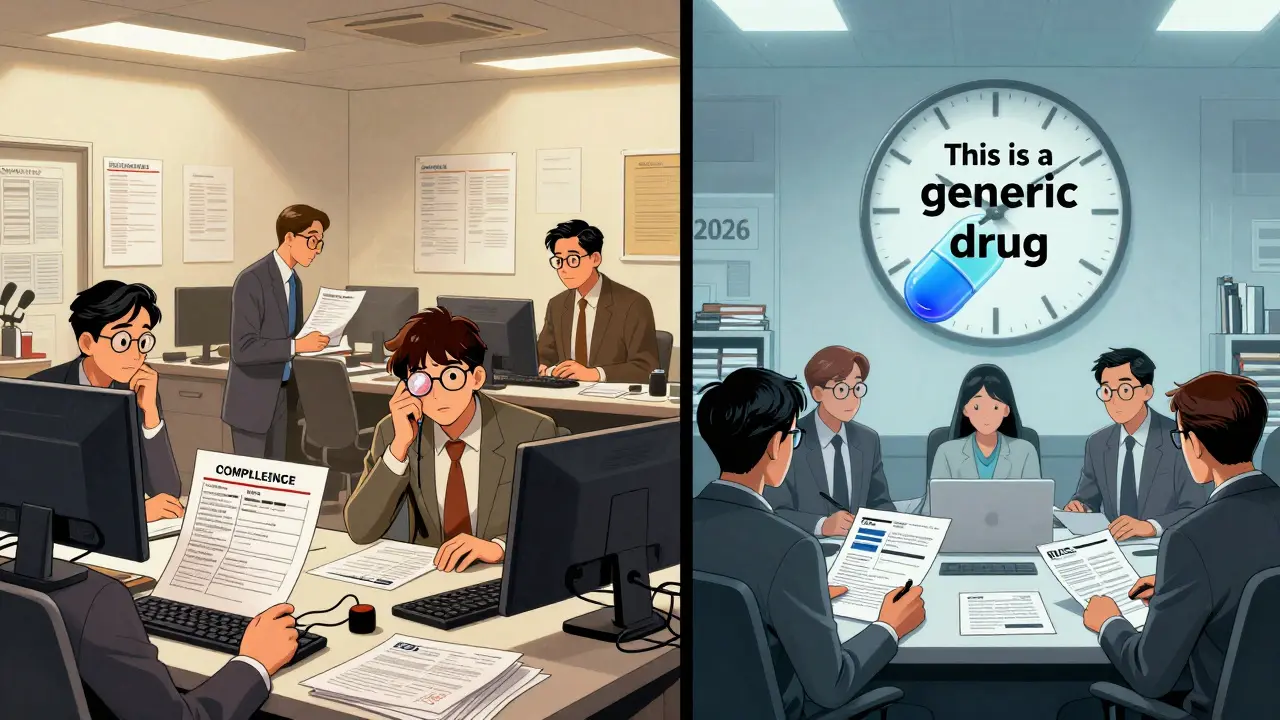
- Ads must now include the phrase "This is a generic drug" in clear, readable text.
- Visual elements must avoid mimicking brand-name packaging. No more matching colors, fonts, or pill shapes.
Compliance teams are scrambling. Companies with fewer than 20 regulatory staff are falling behind. The FDA’s enforcement data shows that only 47% of smaller generic manufacturers are fully compliant - compared to 83% of the top 25.
And it’s not just about fines. A single misleading ad can trigger a cascade: patient lawsuits, lost market share, and reputational damage that lasts years.
Real People, Real Harm
Behind every regulation is a patient. In 2024, the FDA reviewed 1,247 patient complaints tied to false advertising. Thirty-two percent of those patients stopped taking their medication because they believed the generic was unsafe. Many ended up in the ER.
One case from Reddit’s r/pharmacy stands out. A patient with hypothyroidism refused to refill her generic levothyroxine after seeing an ad that claimed "generic thyroid meds cause heart palpitations." She switched back to the brand - at three times the cost. Her doctor later confirmed the generic was perfectly safe. But her TSH levels had spiked dangerously during the switch. She didn’t know the FDA had approved the generic for this exact use.
Another survey by the National Community Pharmacists Association found that 41% of patients are confused about whether generics are truly equivalent. That confusion doesn’t come from lack of information. It comes from cleverly crafted ads that exploit fear.
On the flip side, when ads are truthful? Patients save money. AARP’s 2025 survey found seniors who received clear, compliant messaging reported 78% cost savings - without sacrificing safety.
What Companies Must Do to Stay Legal
Compliance isn’t a one-time audit. It’s a system. Top generic manufacturers now have teams of 15 to 25 people just to review ads. Here’s what they do:
- Check every claim against FDA guidance documents - especially the 2023 revision on "Disclosures in Drug Advertising and Labeling."
- Verify bioequivalence data before using any comparative language.
- Ensure risk information appears in at least 14-point font with 50% contrast - no tiny print.
- Include the reference listed drug name and the phrase "This is a generic drug" in every ad.
- Run ads through legal counsel familiar with state laws - not just federal.
- Document every decision. If you’re sued, your paper trail is your shield.
Training takes time. The Regulatory Affairs Professionals Society says new compliance officers need 18 months to become proficient. That’s not a typo. It’s a commitment.
The Cost of Getting It Wrong
Penalties aren’t just numbers on a spreadsheet. In 2025, the average fine for a single deceptive ad ranged from $10,000 under New York law to $500,000 in Lanham Act cases. But the real cost? Lost trust.
Take GlaxoSmithKline. In 2012, they paid $3 billion for misrepresenting drug data. That’s not just a fine - it’s a scar on their brand that still affects sales today. Smaller companies don’t have that kind of buffer.
And then there’s the market. The U.S. generic drug industry is worth $140 billion. It fills 90% of prescriptions. But if patients believe generics are risky, that market shrinks. And that hurts everyone - patients, pharmacists, and even brand-name companies that rely on generics to keep healthcare costs down.
What’s Next? The Rules Are Only Getting Tighter
Look ahead. H.R. 4582, the "Transparency in Drug Advertising Act," is moving through Congress. It would force all drug ads - brand or generic - to use standardized risk disclosures across TV, radio, and digital platforms. No more "see your doctor" loopholes. No more regional patchwork.
Analysts at Evaluate Pharma predict enforcement actions will rise 35% annually through 2027. Generic manufacturers will be under the loupe. The companies that win? Those that treat compliance as a competitive advantage - not a cost center.
Pfizer’s $45 million advertising review system isn’t just expensive. It’s smart. It’s future-proof. It’s the difference between being a target and being a leader.
Final Thought
Generics aren’t second-rate. They’re the backbone of affordable care. But false advertising turns them into a liability. The rules are clear. The risks are real. And in 2026, the FDA isn’t asking you to play nice - they’re demanding you get it right.
Can generic drug ads say they’re "just as good" as brand-name drugs?
Yes - but only if the generic has been officially rated as "therapeutically equivalent" by the FDA. Simply being bioequivalent isn’t enough. The FDA requires specific approval for therapeutic equivalence, especially for drugs with narrow therapeutic indexes like levothyroxine or warfarin. Ads that say "just as good" without this designation risk violating FDA guidelines and the Lanham Act.
What’s the difference between "FDA Approved" and "FDA Cleared" for generics?
There’s a critical difference. "FDA Approved" means the drug went through the full Abbreviated New Drug Application (ANDA) process and met all safety and efficacy standards. "FDA Cleared" is a term sometimes used incorrectly - it’s not a legal designation. Only approved generics can legally use "FDA Approved" in advertising. Using "cleared" instead is misleading and has triggered multiple Lanham Act lawsuits.
Can generic drug ads mention cost savings?
Yes - but only if you can prove it. The FTC requires substantiation. Saying "saves you 70%" without documented pricing data from pharmacy benefit managers or retail chains is a violation. Generic companies can say "lower cost" or "affordable alternative," but any specific dollar amount must be backed by verifiable records.
Do all states have the same rules for generic drug advertising?
No. While federal law sets the baseline, states like California, New York, and Florida have stricter rules. California requires higher proof for comparative claims. New York allows triple damages. Florida bans government logos in ads. A national campaign must be customized for each state - one-size-fits-all doesn’t work anymore.
What happens if a patient stops taking a generic because of a misleading ad?
If the ad was deceptive and the patient suffered harm - like a relapse, hospitalization, or worsening condition - the company behind the ad can be sued under state consumer protection laws. The FDA’s 2024 analysis found 32% of patient complaints involved health consequences from discontinued generics. These cases are now being actively pursued in civil courts, with some resulting in multi-million-dollar settlements.


Haley DeWitt
Okay, I just read this and I’m honestly shook 😭 Like… I’ve been taking generic levothyroxine for years and never knew ads were manipulating people like this?! My mom used to say "why spend more when it’s the same?" but now I think she was just lucky no one targeted her with fear-mongering ads…
I’m gonna start sharing this with my pharmacy group chat. We need to wake people up before someone gets hurt. Seriously. This isn’t just business-it’s life.
Also, can we PLEASE make ads say "THIS IS A GENERIC DRUG" in giant letters? Like, on the screen for 5 seconds?? I’m not kidding. I’ve seen ads where it’s buried in tiny text under a dancing pill. 😒
And why is no one talking about how they use "FDA Approved" vs "FDA Cleared" like it’s the same thing?? That’s not just misleading-it’s criminal. I’m calling my rep tomorrow.
Adam Short
Let me get this straight-American pharma companies are lying to seniors so they’ll pay 3x more for a pill that’s chemically identical??
BRITAIN DOESN’T ALLOW THIS. We have the NHS. We have transparency. We have laws that don’t let corporations turn health anxiety into a profit stream.
THIS IS WHY AMERICA IS BROKE. Not because of taxes. Not because of debt. Because greedy bastards are gaslighting people into buying expensive versions of the SAME DAMN DRUG.
And now they want to pass H.R. 4582? Good. But it’s too late. The damage is done. Millions are already scared. Millions are paying more. And the FDA? They’re just now catching up??
Shameful.
Linda Franchock
Oh honey, you think this is bad? Wait till you see the ads for insulin generics.
I work in a clinic. Last month, a 72-year-old man came in because his "new generic" made him "feel weird." Turned out he’d seen an ad that said "generic insulin may cause sudden drops in blood sugar"-which, spoiler alert, is 100% false.
He switched back to the brand. Paid $450 a month. His wife cried in my office.
Meanwhile, the ad’s company? Still running it. Still making bank.
And don’t even get me started on the "health alert" banners. I swear, some of these companies hire writers from horror movie studios. "WARNING: THIS PILL COULD KILL YOU."
Meanwhile, the real killer? The price tag.
Kancharla Pavan
It is a profound moral failure of capitalist healthcare systems that corporations are permitted to weaponize ignorance against vulnerable populations under the guise of marketing. The very notion that a pharmaceutical entity can, with impunity, disseminate misinformation regarding the therapeutic equivalence of life-sustaining medications is not merely unethical-it is an act of systemic violence against the working class and elderly.
The FDA’s enforcement in 2026 is long overdue, yet insufficient. Why? Because regulation without teeth is theater. Why are there no criminal charges? Why are executives not personally liable? Why is the burden of compliance placed on 15-person compliance teams rather than on the CEOs who approved these ads?
And let us not forget: the Lanham Act lawsuits are a luxury afforded only to large manufacturers. Small generics? They get crushed. The system is rigged.
The solution? Nationalize drug manufacturing. Remove profit motive. Ensure transparency. Or continue watching people die because they couldn’t afford the truth.
PRITAM BIJAPUR
It’s fascinating how we’ve turned medicine into a psychological battlefield. 🤔
Generics aren’t just drugs-they’re symbols. Symbols of trust. Symbols of equity. Symbols of dignity.
When an ad says "generic thyroid meds cause heart palpitations," it’s not just lying about chemistry-it’s attacking the patient’s sense of safety. It’s saying: "You’re not smart enough to understand this. You’re not worthy of affordable care. You should be afraid."
And yet… we’re still surprised when people panic and stop taking their meds?
Maybe the real issue isn’t the ad. It’s that we’ve let corporations dictate how we feel about our own bodies. 🌱
Imagine if every drug ad started with: "This is a generic. It works. It’s safe. It’s yours."
Just… imagine.
Dennis Santarinala
Man, I read this whole thing and I just… nodded. A lot.
I used to work at a pharmacy. Saw people cry because they couldn’t afford the brand. Saw others refuse generics because they "felt different."
And honestly? Most of them didn’t even know the FDA had a whole database where you can check if a generic is approved for their exact condition. Like… go to drugs.com, type in your med, click "generic equivalents." It’s right there.
So maybe the problem isn’t just the ads… maybe it’s that nobody taught us how to be smart about our meds?
Anyway, I’m printing this out and taking it to my local pharmacist. Maybe we can start a little info booth. "Ask about your generic."
Small steps, right? 😊
guy greenfeld
Wait… what if this is all a distraction?
What if the FDA isn’t cracking down on false ads… what if they’re using this as a smokescreen?
Think about it: they’re suddenly obsessed with generic ads… but what about the brand-name companies that are STILL hiding side effects? What about the ones that pay doctors to prescribe their overpriced pills?
And why now? Why 2026? Coincidence? Or… is this a way to make us think the system is fixing itself… while they quietly pass new laws that let them control the entire supply chain?
I’ve seen the documents. I’ve read the leaks.
This isn’t about truth.
This is about control.
Prateek Nalwaya
It’s wild how language shapes perception. "FDA Approved" vs. "FDA Cleared"-one sounds like a gold seal, the other like a rubber stamp. But they’re not even the same category. And yet, the public doesn’t know the difference.
Same with "bioequivalent"-a word that sounds like a sci-fi term. But what if we called it "same chemical twin"? Or "medically identical"? Would people trust it more?
And here’s the kicker: we’ve got 90% of prescriptions filled with generics… but only 15% of patients feel confident they’re safe.
That’s not a drug problem.
That’s a communication disaster.
Maybe instead of policing ads… we should be teaching patients how to read them. Like, in high school. Like, in every pharmacy. Like, in every doctor’s office.
Knowledge isn’t power. Knowledge is peace.