
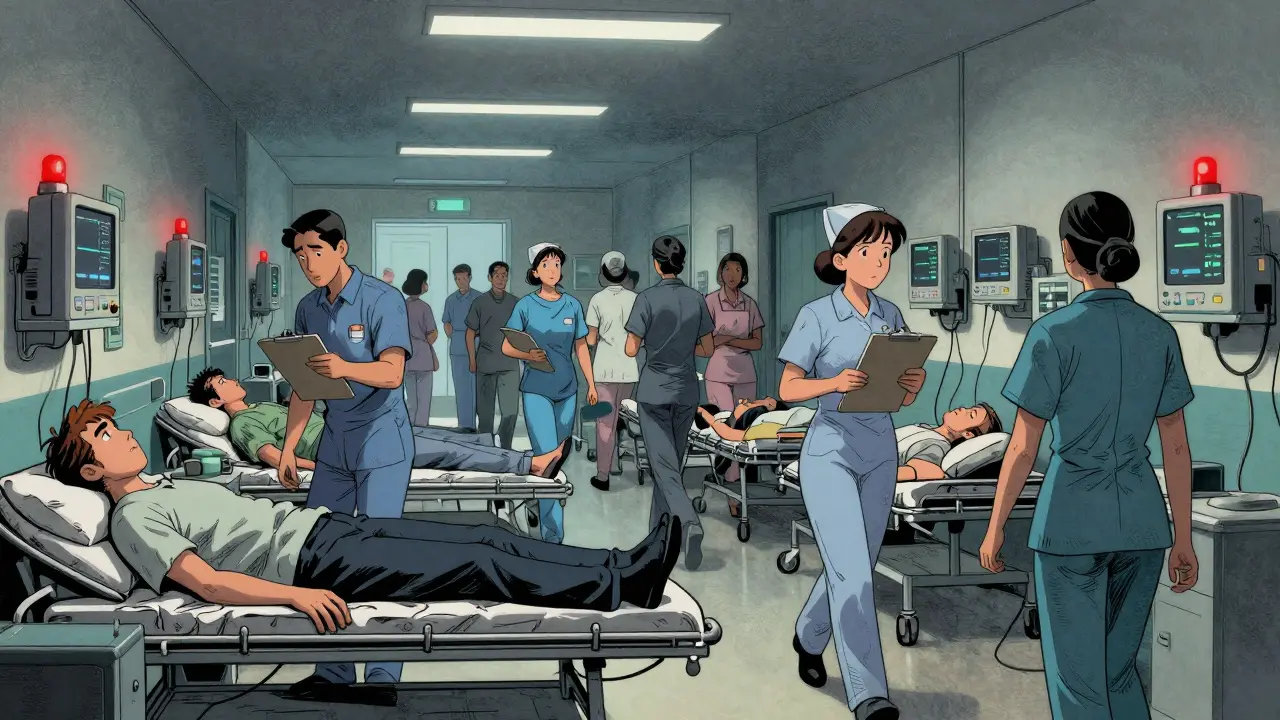
It’s not just about running out of medicine. The real crisis in hospitals and clinics right now is that there aren’t enough people to care for patients. Nurses are quitting. Doctors are overwhelmed. Emergency rooms sit empty not because no one’s sick, but because there’s no one left to treat them. This isn’t a future problem-it’s happening today, in every state, in every type of facility, from big city hospitals to tiny rural clinics.
Why There Aren’t Enough Staff
The numbers don’t lie. By 2030, the U.S. will be short more than 500,000 registered nurses. That’s half a million people who should be checking vitals, giving meds, and holding a patient’s hand-but aren’t. Why? It’s not one thing. It’s a perfect storm.First, a huge chunk of the nursing workforce is hitting retirement age. Nearly half of all nurses are over 50. Many of them worked through the worst of the pandemic, pushed to the edge, and now they’re walking away. At the same time, nursing schools can’t train enough new nurses because there aren’t enough faculty to teach them. Over 8% of nursing professor positions are vacant right now. That means even if someone wants to become a nurse, they might get turned away because the class is full.
Then there’s burnout. Nurses are working 16-hour shifts. Some are assigned five or six patients at once-when the safe standard is one or two. In places where nurse-to-patient ratios hit 1:4 or worse, patient death rates go up by 7%. That’s not just a statistic. That’s someone’s parent, sibling, or child who didn’t get the care they needed because their nurse was stretched too thin.
What’s Happening in Hospitals
Hospitals are running on fumes. Forty-two states will face nursing shortages by 2030, according to the American Hospital Association. In some places, they’ve had to close beds-not because they don’t have the space, but because there’s no staff to staff them. One hospital CEO in Ohio reported losing $4.2 million a month just from having to shut down 12 inpatient beds each week.Emergency departments are the first to feel it. Wait times have jumped 22% since 2022. People are sitting in hallways for hours, sometimes days. In rural Nevada, patients have waited up to 72 hours just to be seen. That’s not an anomaly-it’s becoming the norm. And it’s not just delays. When staff are stretched too thin, mistakes happen. Nurses on Reddit have shared stories of near-miss medication errors because they were juggling too many patients at once.
Even the most advanced hospitals are struggling. Academic medical centers are running at 82% staffing. Rural hospitals? Only 67%. That gap isn’t just about money-it’s about access. If you live in a small town, your chances of getting timely care are already lower. Now they’re getting worse.
Clinics Are Crumbling Too
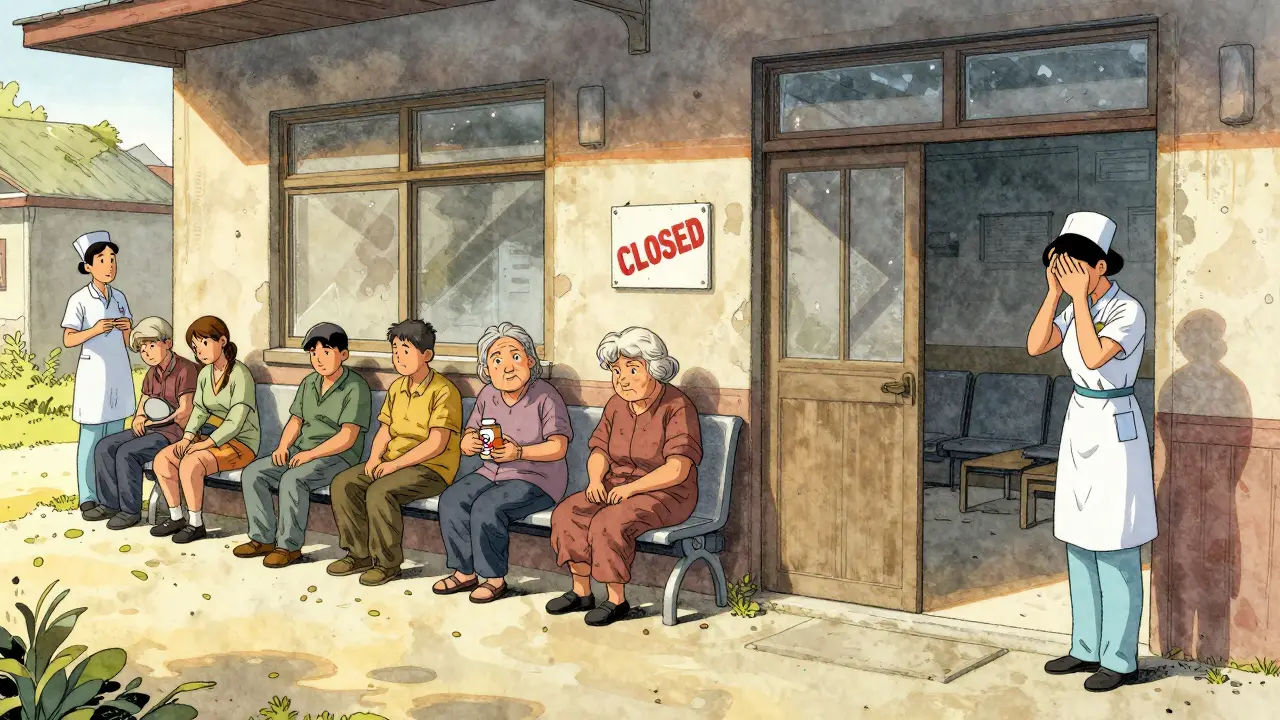
It’s not just hospitals. Outpatient clinics-where people go for checkups, chronic disease management, and minor emergencies-are also collapsing under pressure. Rural clinics are operating at just 58% staffing. That means fewer physicals, delayed diabetes checks, missed cancer screenings. People aren’t getting sicker overnight. They’re getting sicker slowly, because they can’t get in to see anyone.Behavioral health is the worst. There’s a shortage of mental health providers so severe that the Department of Health and Human Services says every specialty will be affected by 2036. Someone having a panic attack, someone struggling with addiction, someone in deep depression-many of them have nowhere to turn. Emergency rooms are becoming de facto mental health centers, and they’re not equipped for it.
The Band-Aid Solutions That Aren’t Working
Hospitals have tried to patch the problem with travel nurses. In 2023, they filled 12% of open positions this way. But it’s expensive. Travel nurses earn up to $185 an hour in big cities like New York. Permanent staff making $65 an hour see that and feel betrayed. Morale drops. Turnover rises. It’s a cycle.Some hospitals are turning to AI. Tools that automate charting or triage patients over video call sound promising. One pilot program cut ER visits by 19%. But these tools need training. Staff need 32 hours of instruction just to learn how to use them. And not every clinic can afford the $2.3 million it costs to roll them out. Plus, most electronic health records still don’t talk to each other. If your clinic uses one system and the hospital uses another, the patient’s data gets lost.
States are trying too. California passed laws forcing hospitals to limit nurse-to-patient ratios. Massachusetts offers loan forgiveness to nurses who work in underserved areas. Those help-but they’re local fixes for a national problem. The federal government spends $247 million a year on nursing education. Experts say it needs $1.2 billion.
Who’s Getting Left Behind
The impact isn’t spread evenly. Rural communities get hit hardest. They already had fewer doctors. Now they have even fewer nurses. Older adults, people with chronic illnesses, low-income families-they’re the ones who suffer most. They can’t drive 90 minutes to the nearest hospital. They can’t afford to miss work for a 12-hour wait in the ER.And it’s not just about quantity. It’s about quality. When nurses are exhausted, they can’t spend time explaining a new medication. They can’t notice subtle changes in a patient’s condition. They can’t offer comfort. The human side of care disappears. And that’s what makes healthcare more than just a system-it’s a relationship.

What Could Actually Help
There are real solutions-but they take time, money, and political will.One model that works? The Mayo Clinic’s Care Team Redesign. It took 18 months, $4.7 million, and hundreds of staff hours. But it cut nurse turnover by 31%. How? They restructured teams so nurses weren’t doing admin work. They hired support staff to handle paperwork. They gave nurses more control over their schedules. They listened.
Another idea: expand nursing school capacity. Train more people. Pay them to teach. Pay them to stay. Offer housing stipends for nurses working in rural areas. Let nurses from other states practice here without waiting 112 days for licensing approval.
And yes-use technology. But not as a replacement. Use it as a tool. Let AI handle scheduling and charting so nurses can focus on patients. Use telehealth to connect rural clinics with specialists. But don’t expect a robot to hold someone’s hand while they’re scared.
The truth is, we can fix this. But not by asking nurses to work harder. We have to fix the system that broke them.
What Comes Next
The shortage isn’t going away soon. Experts predict it’ll peak in 2027 and last until at least 2035. Without major investment, we’re looking at 15 million fewer healthcare workers globally by then. That means more preventable deaths. More families losing loved ones too soon. More doctors walking out.But it’s not hopeless. The University of Pennsylvania estimates that with $22 billion in targeted investment, technology and better workflows could offset 40% of the shortage by 2030. That’s not a cure-but it’s a lifeline.
What we need now is urgency. Not more reports. Not more meetings. Real action: more funding for education, better pay for frontline workers, fairer schedules, and respect for the people who show up every day when no one else will.
If we don’t act, the next time you or someone you love needs care, there might not be anyone there to help.
Why are hospitals closing beds if they still have patients?
Hospitals close beds not because they’re empty, but because they don’t have enough staff to safely care for patients in them. A bed without a nurse is a liability. If a patient has a cardiac arrest or starts bleeding, no one can respond. Many hospitals now only open beds when they have a full team assigned-nurses, aides, and sometimes even doctors-to handle the workload. Closing beds is a last resort to avoid medical errors and protect both patients and staff.
Are travel nurses making the problem worse?
They’re a temporary fix, not a solution. Travel nurses fill critical gaps, especially in high-demand areas like ICUs and ERs. But their high pay-sometimes triple what permanent staff earn-creates resentment and makes it harder to retain local nurses. Hospitals end up spending more money on temporary staff than they would on raising wages or improving conditions for their own employees. It’s like using duct tape on a broken pipe-it keeps water from spraying out, but the pipe still needs to be replaced.
Why don’t more people become nurses if there’s such a shortage?
Many do want to. But nursing schools can’t accept them. There aren’t enough instructors, clinical placements, or classroom space. In 2023, over 2,300 qualified applicants were turned away from nursing programs just because there wasn’t room. On top of that, the job has become physically and emotionally exhausting. Nurses report unsafe patient ratios, mandatory overtime, and little support. Even if someone gets in, many leave within five years because they can’t keep going.
Can AI really solve the staffing crisis?
AI won’t replace nurses, but it can take over repetitive tasks like charting, scheduling, and alerting staff to potential risks. One study showed AI tools reduced documentation time by 30%, giving nurses back hours each week. But these tools require training, reliable tech, and good data systems-things many rural clinics don’t have. AI helps, but only if it’s used to support people, not replace them.
What can patients do if they’re facing long waits or poor care?
Patients can report unsafe conditions to hospital administrators or state health departments. Many states now require hospitals to report staffing levels publicly. You can also ask to speak with a patient advocate or file a formal complaint through your insurance provider. While one voice won’t fix the system, collective pressure from patients and families is one of the few forces that can push hospitals and lawmakers to act.


Tony Du bled
The system is just broken beyond band-aids. I saw my grandma wait 36 hours in an ER hallway last year. No nurse came by for hours. She wasn’t even sick enough to be admitted, just too old and too poor to get priority. People aren’t dying because of lack of medicine-they’re dying because no one’s got the bandwidth to notice they’re fading.
And don’t get me started on travel nurses. Yeah, they’re saving lives right now, but they’re also draining the soul out of the place. Permanent staff see them rolling in at $180/hour and wonder why their 12-hour shifts with no lunch break aren’t worth the same. It’s not greed-it’s exhaustion.
We’re treating healthcare like a startup that needs a pivot, not a public good that needs protection.
Kathryn Weymouth
The data presented here is both accurate and deeply alarming. The nursing faculty shortage-over 8% of positions vacant-is a structural bottleneck that directly limits workforce growth. Without addressing this, no amount of loan forgiveness or AI integration will resolve the crisis at its root. Additionally, the 7% increase in patient mortality associated with nurse-to-patient ratios exceeding 1:4 is not merely statistical; it is an ethical failure. The federal investment of $247 million annually for nursing education is less than 20% of the estimated $1.2 billion required. This disparity reflects a systemic devaluation of care work that must be corrected through policy, not rhetoric.
Julie Chavassieux
Someone’s gonna get sued over this
Herman Rousseau
I’ve worked in rural clinics for 15 years. We don’t have travel nurses. We don’t have AI. We have one RN who does triage, admin, med admin, and calls the doctor when things go south. She’s 58 and still shows up every day. We’ve lost three staff in the last year alone. One quit because her kid got sick and she had no PTO. Another left because she couldn’t sleep after a 14-hour shift where she had to manage seven patients and two code blues.
Here’s what actually works: hire scribes. Pay nurses to teach. Let them pick their own shifts. Stop treating them like disposable parts. We don’t need a miracle. We need someone to listen.
And yes-AI can help with charting. But no robot is gonna hold a dying man’s hand and tell him it’s gonna be okay. That’s the part we’re losing.
Vikrant Sura
Why are we even talking about this? Nurses make too much money already. Just make them work longer. Everyone else has to. You think I complain about my 80-hour weeks at the warehouse? No. Because I’m not a crybaby. Stop coddling people. The system works fine if you just stop being lazy.
Candy Cotton
This is what happens when you abandon American values and outsource everything. We used to have a strong, self-reliant healthcare system. Now we beg foreign nurses and import AI from Silicon Valley. The solution is simple: stop letting unqualified foreigners into our nursing programs. Enforce strict English fluency standards. Reward American citizens who choose this noble profession. And cut the funding to universities that prioritize diversity over competence. This crisis is not about pay-it’s about cultural decay.
Kiranjit Kaur
My aunt in Kerala is a nurse. She works 12-hour shifts in a public hospital with 30 patients and 2 aides. No one gets paid enough. No one gets rest. But she still smiles when she walks in. I think we’ve forgotten that healthcare isn’t just about systems-it’s about people showing up, even when it breaks them.
Let’s stop treating nurses like machines and start treating them like humans. Give them space. Give them support. Give them a damn break.
And if you’re reading this and you’re in a position to help-don’t just share this post. Call your rep. Donate to a nursing school. Volunteer at a clinic. Small things add up.
❤️
Sai Keerthan Reddy Proddatoori
Big Pharma and the government are in cahoots. They don’t want enough nurses because then people would get healthy and stop buying pills. That’s why they let schools close. That’s why they pay travel nurses crazy money-it keeps the system unstable so people keep getting sick. And don’t believe that AI nonsense. They’re just trying to replace humans with robots so they can track your every move. You think your EHR is secure? It’s sold to data brokers. Wake up.