
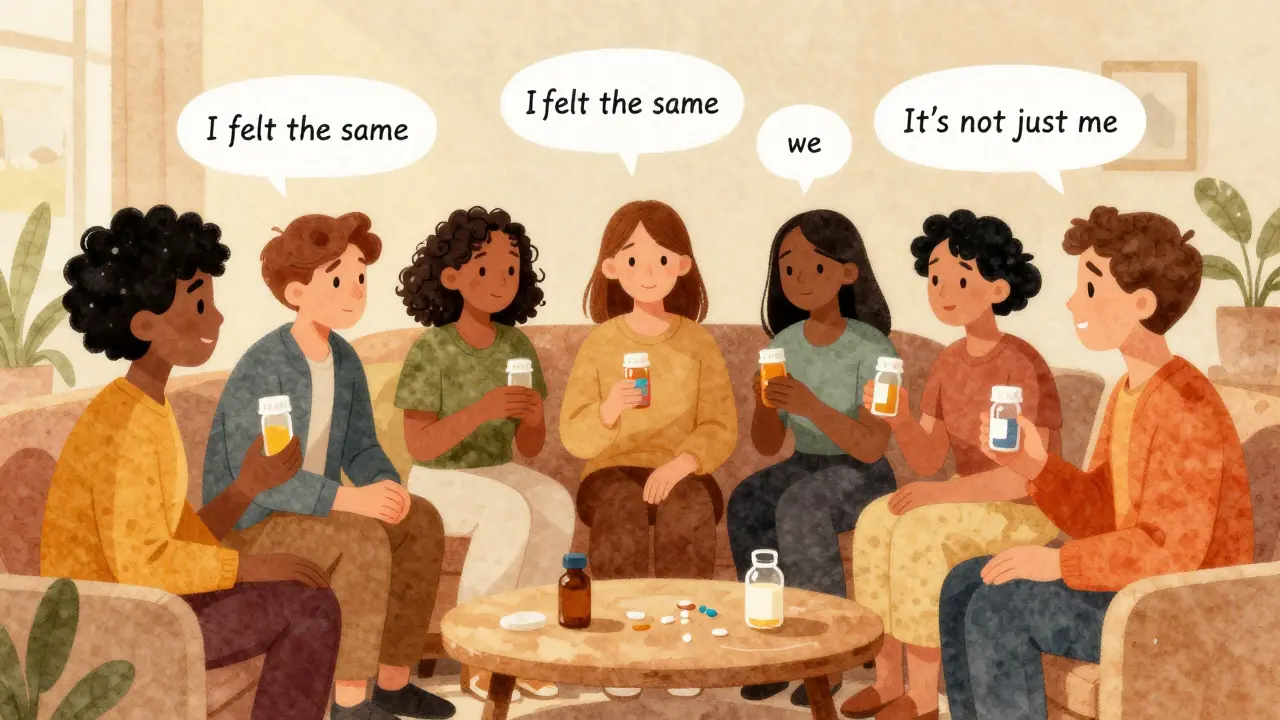
When you switch from a brand-name pill to a generic version, it’s not just a cost change-it’s a mental shift. You might feel fine one day, then notice a slight difference the next. Is it the medicine? Or is it your mind? That’s where patient support groups come in. They’re not clinics. They’re not pharmacies. They’re real people-neighbors, coworkers, strangers online-who’ve been there and are willing to say, "I felt the same way. Here’s what happened." These groups didn’t start because doctors told patients to join. They started because patients were scared, confused, and tired of being told, "It’s the same thing," without anyone explaining what that actually meant in real life.
Why Generic Medications Feel Different (Even When They’re Not)
The FDA says generics must be bioequivalent to brand-name drugs-meaning they deliver the same active ingredient at the same rate and strength, within a tight 80-125% range. That’s science. But science doesn’t always explain how you feel. People report everything: a different pill shape, a new coating that tastes bitter, or even just a nagging doubt that makes them feel off. One man on Reddit switched his generic statin and thought he was having heart palpitations. Turns out, he was just anxious. Another woman with diabetes said her insulin generic made her feel "dizzy and foggy." Her doctor checked her blood sugar-perfectly stable. The symptoms vanished after she joined a support group and heard 12 others describe the exact same thing. This isn’t placebo. It’s the nocebo effect-when expecting something bad makes you feel it. Support groups help break that cycle by normalizing the experience. When you hear someone say, "I thought I was losing my mind too," it changes everything.Where These Groups Live (And How to Find Them)
You don’t need to drive across town. Most support groups exist where people already spend time: online. - Facebook groups like "Generic Medication Users United" have over 14,000 members. New users often post: "Is it just me?" Within days, they get replies from people who’ve been on the same drug for years. - Reddit communities like r/Pharmacy and r/Depression have threads where people compare experiences with generics for antidepressants, blood pressure meds, and thyroid drugs. One 2022 thread about generic statins had 472 comments-76% of people who were worried ended up feeling better after two weeks. - In-person groups still matter, especially in rural areas. Community health centers in places like Mississippi and West Virginia host monthly meetings led by pharmacists. These aren’t sales pitches. They’re Q&As where patients bring their pill bottles and ask, "Why does this one make me sleepy?" The trick? Not all groups are created equal. Some are run by patients. Others have pharmacists or nurses moderating. The best ones verify claims. A 2009 study found 34% of online discussions about generics contained false info. But when pharmacists were involved, that dropped to 8%.What Makes a Good Support Group?
A good group doesn’t just let people vent. It helps them understand. The most effective ones follow three rules:- Verify facts-If someone says, "This generic doesn’t work for migraines," a moderator checks if it’s the same active ingredient and dosage as the brand.
- Share real data-They link to studies like the 2019 JAMA analysis of 47 trials showing generics for heart disease work just as well.
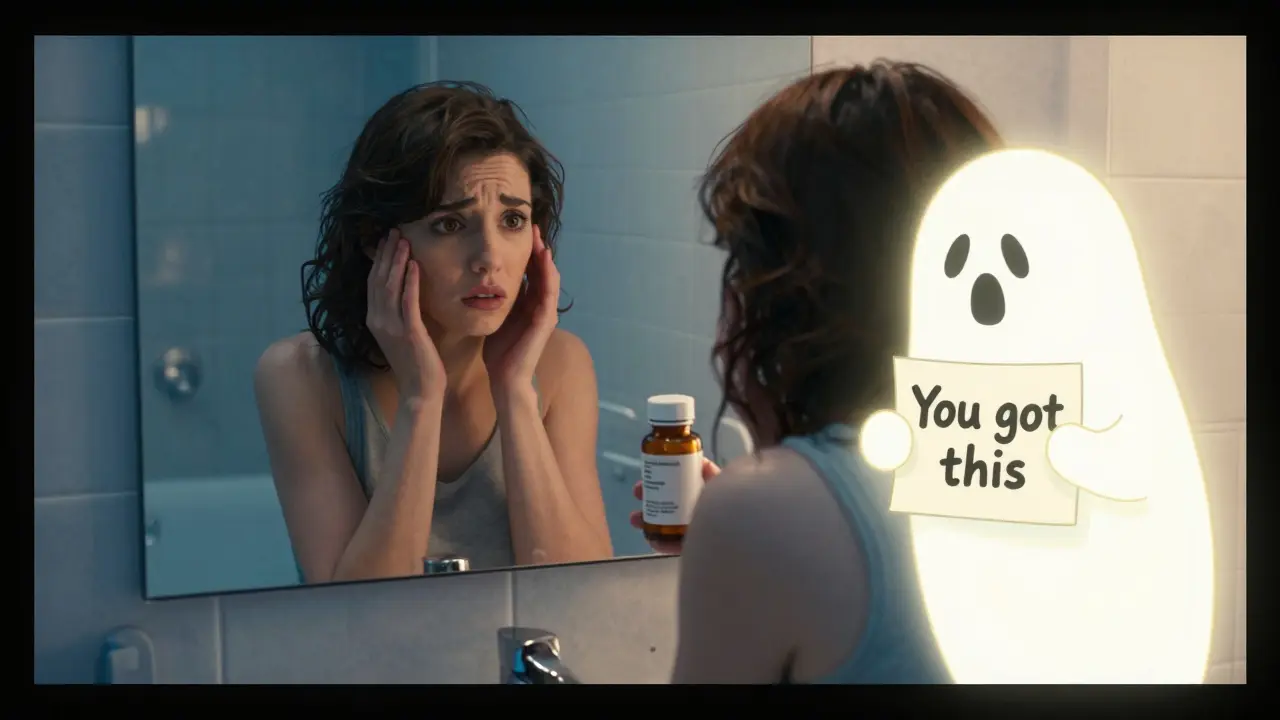
- Pair new members with veterans-A "buddy system" helps newcomers feel less alone. One woman in a diabetes group was terrified to switch her insulin. Her buddy had done it two years earlier. She sent her a photo of her new pill bottle with the note: "This one saved me $300 a month. You got this."
Who Benefits the Most?
It’s not just people on a budget. It’s anyone who’s been told, "It’s the same," and didn’t believe it. - Seniors on Medicare: 58% participate in support groups. Many switch to generics to afford other essentials like food or heat. - People with chronic conditions: Hypertension, diabetes, thyroid disorders, depression. These require daily meds for years. A small cost difference adds up fast. - Rural communities: 63% fewer in-person groups exist there. But online access levels the playing field. One study showed rural patients who joined groups were 40% more likely to trust generics than those who only got brochures. - Minority populations: African American patients in the rural South reported higher trust in generics after culturally tailored group discussions. Language, cultural context, and lived experience matter.The Dark Side: When Groups Go Wrong
Not every group helps. Some spread fear. In 2019, a Facebook group for epilepsy patients wrongly blamed generic seizure meds for increased seizures. Turns out, the patients’ condition was worsening naturally. But because no one checked, 17 people stopped their meds. One ended up hospitalized. That’s why oversight matters. Groups with no medical input are dangerous. The FDA and American College of Physicians both warn that unverified anecdotes can reinforce myths like, "Generics are weaker" or "They’re made in China so they’re unsafe." The fix? Look for these signs:- Are pharmacists or nurses responding to medical questions?
- Are members citing FDA or peer-reviewed studies?
- Is there a rule against stopping meds without a doctor’s approval?
How This Changes Real-World Care
Doctors aren’t ignoring patients. Many don’t know what patients are hearing. The ACP’s IMPROVE project connected support group insights directly to 141,000 physicians and 205,000 nurse practitioners. Result? Doctors started asking different questions. Instead of, "Are you taking your pill?" they asked, "What did you hear about this generic?" That shift led to a 18% increase in generic prescribing in pilot programs. Why? Because now doctors understood the fear wasn’t irrational-it was real. One endocrinologist in Ohio said she used to assume patients weren’t adhering. Now she asks, "Did you talk to anyone else about this?" Half the time, they had. And she learned more from those conversations than from any textbook.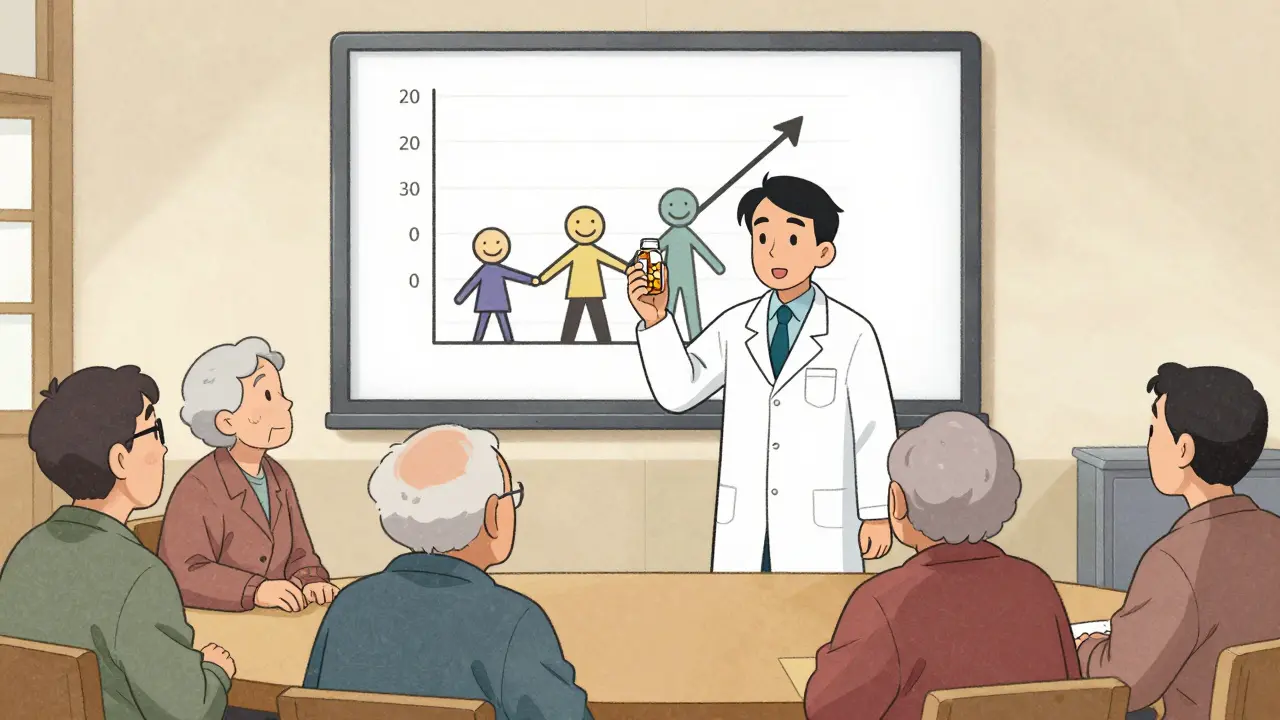
What’s Next?
The FDA launched its Patient Experience Metrics program in 2023. That means patient stories from support groups could soon influence how drugs are approved. The Association for Accessible Medicines is building a verified directory of support groups, launching in Q2 2024. Think Yelp for medication communities-rated by medical accuracy, not popularity. Pharmacy benefit managers are starting to link support group data to electronic health records. Imagine your doctor seeing a note: "Patient is in a verified group for hypertension generics. Adherence improved 22% in 6 months." This isn’t science fiction. It’s happening now.What You Can Do Today
If you’re on a generic medication and have doubts:- Find a group with a pharmacist or nurse involved.
- Ask: "Has anyone else had this reaction?"
- Don’t stop your meds. Talk first.
- Bring your pill bottle to your next appointment and say: "I read this in a group. Can we check if it’s possible?"
- Don’t dismiss concerns. Say: "Tell me more about what you’ve heard."
- Share a trusted group link. The ACP has free conversation guides for providers.
- Encourage your clinic to partner with local groups.
Final Thought
Generic medications aren’t just cheaper. They’re safer when used correctly. But trust doesn’t come from a pamphlet. It comes from hearing someone say, "I was scared too. But I’m still here." That’s the power of a patient support group. Not because they’re experts. But because they’ve lived it.Are generic medications really the same as brand-name drugs?
Yes-by FDA standards. Generics must contain the same active ingredient, strength, dosage form, and route of administration as the brand-name version. They must also be bioequivalent, meaning they deliver the drug into your bloodstream at the same rate and extent, within a strict 80-125% range. Over 47 clinical trials, including a major 2019 JAMA study, confirmed this for heart medications, antidepressants, and diabetes drugs. The differences you feel aren’t usually from the drug itself-they’re from pill shape, coating, or your expectations.
Why do some people feel worse after switching to a generic?
Often, it’s not the drug-it’s the mind. This is called the nocebo effect: expecting side effects can make you feel them. A pill that looks different, tastes odd, or comes in a new bottle can trigger anxiety. Support groups help by showing you others felt the same way-and then felt better. In one study, 29% of epilepsy patients reported reduced effectiveness after switching, but objective tests showed no change. Once they heard from others, symptoms faded.
Can I trust online patient groups about generics?
Some can, some can’t. Look for groups with healthcare professionals moderating-pharmacists or nurses who verify claims. Groups like those linked by the American College of Physicians or the Generic Drug Patient Alliance have strict rules. Avoid groups where people share stories without evidence or encourage stopping meds. A 2009 study found 34% of online discussions contained false info. With professional oversight, that drops to 8%.
Do support groups really help people take their meds longer?
Yes. FDA research in 2022 showed patients on generics had 15-20% higher adherence than those on brand-name drugs, mostly because they cost less. But support groups boost that even more. University of Chicago studies found that for every increase in patient comfort talking about generics, medication use rose by 6.3%. When people feel heard, they stick with treatment.
How can I find a reliable patient support group for generics?
Start with trusted sources. The American College of Physicians offers free conversation guides and group referrals. Look for groups on Facebook or Reddit that mention pharmacist moderation. Check if they link to FDA or peer-reviewed studies. Avoid groups that promote fear or sell products. The Association for Accessible Medicines will launch a verified directory in Q2 2024-watch for that. For now, ask your pharmacist: "Do you know of any local or online groups for [your condition] and generics?"
Do support groups work for acute conditions like infections?
Not really. Support groups for generics are most effective for chronic conditions-like high blood pressure, diabetes, or depression-where you take the same drug daily for months or years. For short-term meds, like antibiotics or painkillers, switching generics rarely matters. The emotional and financial weight of long-term use is what drives the need for peer support.
Can patient groups actually change how doctors prescribe?
Yes. The IMPROVE project, led by the University of Chicago, connected patient stories from support groups directly to over 140,000 doctors and 200,000 nurse practitioners. Doctors who listened to patient experiences increased generic prescribing by 18%. They stopped assuming patients were noncompliant and started asking, "What did you hear about this?" That small shift changed outcomes.
How much money can I save by switching to generics?
A lot. In 2022, generics made up 90% of all prescriptions filled in the U.S. but only 12% of total spending. That means patients saved $313 billion that year. For example, switching from brand-name insulin to a biosimilar can save $300-$400 per month. For chronic conditions, that adds up to thousands over a year. Support groups help people find those savings without risking their health.

Nicholas Miter
i’ve been on generic lisinopril for 3 years now. never had an issue. but i get it-when the pill looks different, your brain just starts screaming "is this gonna kill me?" it’s weird how much a color change can mess with you.
Suresh Kumar Govindan
The FDA’s bioequivalence parameters are statistically meaningless to individual physiological variance. One must question the institutional epistemology that reduces human pharmacodynamics to a 95% confidence interval. The pharmaceutical-industrial complex thrives on this reductionism.
James Nicoll
so we’re saying the placebo effect is real… but only when it’s negative? cool. so if i think my generic antidepressant is making me cry more, it’s because i’m scared of the pill shape, not because my brain is still broken? genius. 🤡
Uche Okoro
Empirical validation of the nocebo phenomenon is contingent upon the ontological primacy of neurochemical homogeneity. However, the absence of pharmacokinetic divergence does not negate the psychosomatic amplification induced by perceptual dissonance in chronic medication regimes.
Peter Sharplin
My mom switched to generic levothyroxine last year. She swore it made her feel sluggish. We found a Reddit group where 20 people had the same exact complaint. They all switched back to brand and felt fine. Then they checked their TSH levels-identical. The only difference? They stopped believing they were being poisoned. That’s powerful.
John Wippler
you ever notice how the most hated generic pill? the one that feels like a tiny rock in your throat? turns out, it’s the same damn active ingredient as the brand. but the coating’s cheaper, so your tongue screams betrayal. your body doesn’t care. your brain? it’s screaming into a void. support groups don’t fix the pill-they fix the story you’re telling yourself about it. and that? that’s everything.
Faisal Mohamed
the nocebo effect is just capitalism’s way of making us pay more for the same chemical 🧪💸
also, why do generics always taste like regret? 🤔
eric fert
okay but let’s be real-this whole thing is a scam. the FDA says generics are bioequivalent, but have you ever looked at the excipients? talc, magnesium stearate, FD&C dyes, corn starch… some of these are literally the same as what’s in cheap cereal. and don’t get me started on the manufacturing facilities. 80% of generic pills are made in India or China. you think they’re testing every batch like they do in the U.S.? please. the FDA does random spot checks. ONE PERCENT. ONE. PERCENT. Meanwhile, the brand-name companies are spending billions on ads telling you your life depends on the blue capsule with the little stripe. and now we’re supposed to trust a bunch of random people on Facebook who say, "I felt better after switching back"? that’s not evidence-that’s fearmongering dressed up as community. and don’t even get me started on how these groups quietly push people to stop meds. i’ve seen it. people post "my BP spiked after the switch"-no lab results, no doctor note-and suddenly 50 people say "DON’T TAKE IT!!" and then they go off their meds and end up in the ER. and the worst part? no one gets held accountable. no one’s auditing these groups. no one’s checking if they’re funded by brand-name pharma trying to scare people away from generics. this isn’t support. it’s a minefield wrapped in a hug.