
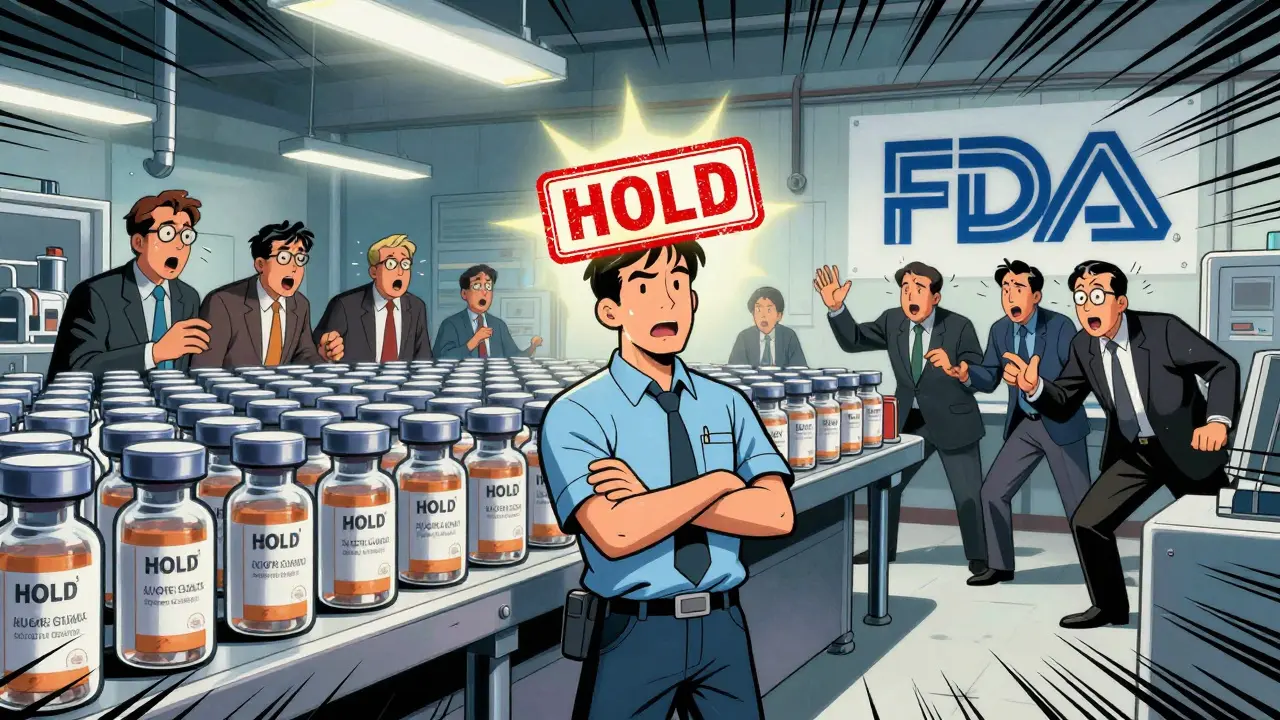
When a batch of medicine fails inspection, it’s rarely because someone made a mistake on the floor. More often, it’s because the people who were supposed to stop that batch didn’t have the power to do it. That’s the core problem behind nearly 70% of FDA warning letters issued in 2024 - and it all comes down to one thing: whether the Quality Assurance Unit (QU) was truly independent.
What Is a Quality Assurance Unit, Really?
A Quality Assurance Unit isn’t just another department that checks paperwork. It’s the final gatekeeper. Under FDA regulations (21 CFR 211.22), the QU has the legal authority to approve or reject every component, container, label, and finished product. That means if a batch doesn’t meet specs - even if it’s 99% perfect - the QU can and must hold it back. This isn’t about being picky. It’s about safety. In pharmaceuticals, one contaminated batch can kill. In nuclear facilities, one overlooked flaw can trigger a cascade failure. The QU’s job isn’t to help production run faster. It’s to make sure nothing leaves the door that shouldn’t. The key word here is independent. The FDA’s 2006 guidance made it crystal clear: the QU must not report to production managers. If the head of manufacturing also controls quality decisions, pressure to meet targets will always win over safety. And it’s not just theory - FDA data shows that when the QU reports up through production, the chance of a data integrity violation jumps by 63%.Why Independence Isn’t Optional
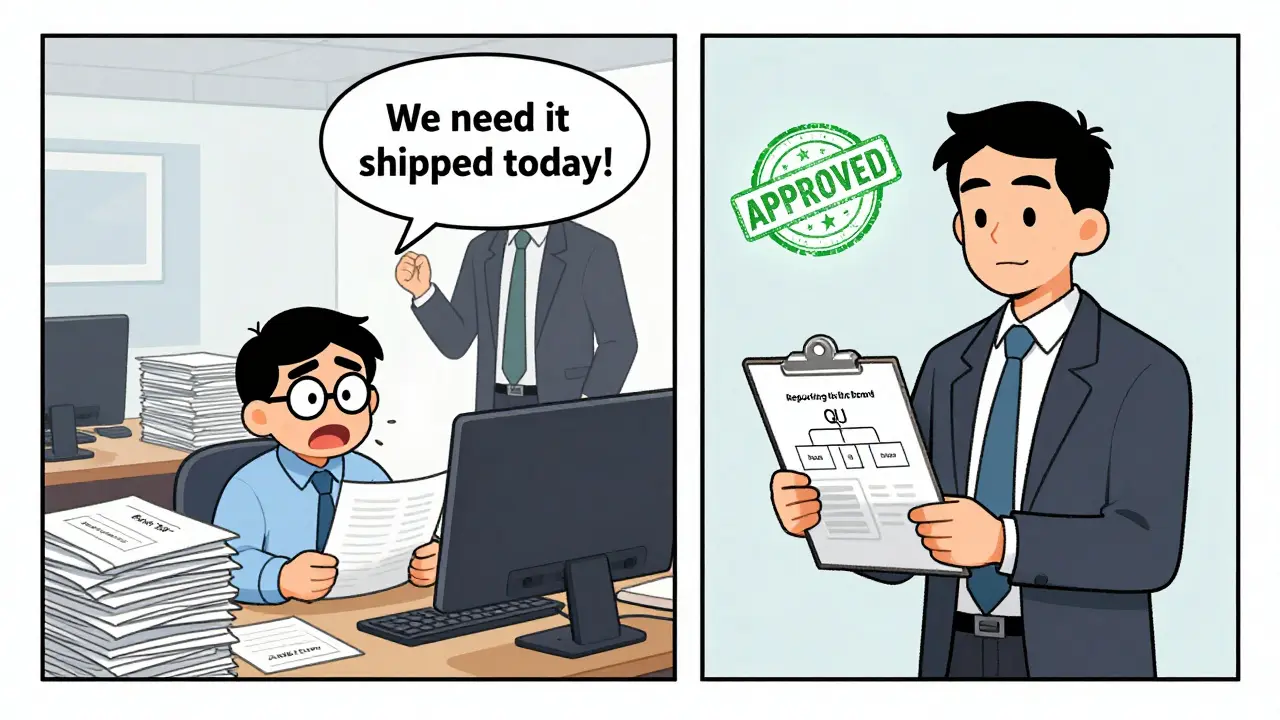
Think of it like a bank’s internal audit team. If the same person who handles cash also approves the daily reconciliation, you’re asking for trouble. The same logic applies to manufacturing. In 2023, a mid-sized pharma plant in Ohio tried to cut costs by merging the QU into the production team. The production manager became the acting quality lead. Within six months, two batches were released with incorrect potency levels. Neither had been properly reviewed. The FDA issued a warning letter. The plant shut down for three months. Cost savings? Gone. Reputation? Destroyed. The IAEA found that organizations with true QU independence have 37% fewer critical compliance failures during inspections. Why? Because independent staff can say “no” without fear. They can demand root cause analysis. They can halt production. They don’t have to worry about their bonus being tied to output numbers. In contrast, facilities where QU staff report to production managers see 42% more independence-related violations - especially in smaller companies with fewer than 50 employees. Why? Because in small teams, roles blur. One person does everything. And when that person is pressured to keep the line running, quality becomes an afterthought.How Independence Actually Works in Practice
It’s not enough to just call someone “Head of Quality.” You need structure. A compliant QU must:- Report directly to senior leadership - ideally the CEO or Board of Directors
- Have its own budget, separate from production
- Control access to batch release records
- Be the only unit with authority to reject a batch
- Have documented procedures for “quality holds” that bypass production management
How Different Industries Handle It
Pharmaceuticals and nuclear energy handle independence differently - and that’s worth understanding. In the U.S., the FDA demands total separation. The QU cannot be subordinate to production under any circumstances. The European Medicines Agency (EMA) allows a bit more flexibility - as long as there are “effective mechanisms” ensuring quality decisions remain unbiased. But even EMA now says, in its 2024 update to EudraLex, that quality units “shall not be organizationally subordinate to production departments under any circumstances.” That’s a hard line. Nuclear facilities go even further. They use a four-layer oversight model:- Peer checks on the production floor
- Supervisor reviews
- Independent oversight (the QU)
- External regulators (IAEA, WANO)
What Happens When Independence Fails
The failures aren’t dramatic. They’re quiet. A batch gets approved because “it’s fine for now.” A deviation gets logged but never investigated. A lab result gets backdated to meet a deadline. Reddit user ‘QualityAssurancePro’ shared a story from 2024: their company merged QA and production under one manager. Three months later, two batches were released with incorrect labels - one contained the wrong dosage. No one had caught it. The QU had no authority to override the manager. The FDA found out during an unannounced inspection. The plant was shut down for 47 days. The cost? Over $2.1 million in lost production, fines, and remediation. FDA data shows that facilities with QU-to-production staff ratios below 1:15 have 3.2 times more repeat deviations. Why? Because when one quality person is responsible for 15 production lines, they’re drowning. They start rubber-stamping. They skip audits. They miss trends. And here’s the kicker: 57% of quality professionals surveyed in 2025 said they’ve been pressured to speed up batch reviews during production crunches. One-third admitted their QU didn’t have the real authority to stop a batch - even though regulations say they do.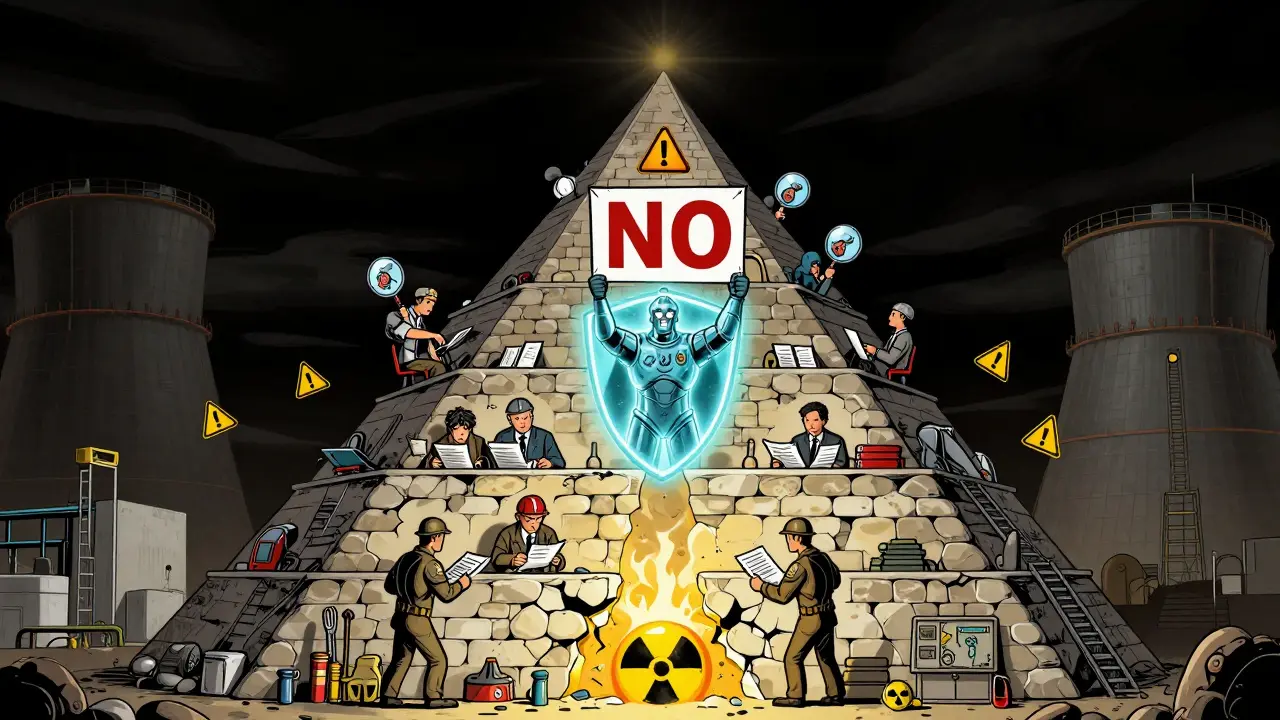
How to Build a Real Independent QU
If you’re setting this up from scratch, here’s how to do it right:- Design the reporting line first. The QU head must report to the CEO, CFO, or Board - not to the VP of Manufacturing.
- Give them budget control. Their budget must be separate. No production funds can touch quality decisions.
- Document everything. 95% of FDA warning letters cite inadequate documentation of QU authority. Have a clear org chart. Publish the QU’s scope of authority. Make it public inside the company.
- Train everyone. Use “quality ambassadors” - production staff trained by the QU to spot issues early. Eli Lilly’s program cut quality culture gaps by 40%.
- Protect them. Create a whistleblower policy that shields QU staff from retaliation. The IAEA says this is non-negotiable.
- Measure it. Track how many quality holds are overridden. Track how long it takes to resolve deviations. If your QU is truly independent, deviation resolution time drops by 28%.
The Future: AI and Digital Manufacturing
New tech is changing the game. AI now monitors real-time sensor data to predict quality issues before they happen. But here’s the problem: if the AI is controlled by the production team, it might learn to ignore “minor” deviations to keep the line running. That’s why the FDA released draft guidance in January 2025 on “Quality Unit Independence in Digital Manufacturing Environments.” The message? Even in automated systems, the final decision-making authority must remain separate. Algorithms can flag issues. Humans must decide. The future won’t be about physical separation. It’ll be about decisional separation. The QU must have the final say - whether that’s a person or an algorithm they control.Bottom Line
Quality Assurance Units aren’t a cost center. They’re your insurance policy. The $14.3 billion global market for quality assurance is growing because companies are realizing that cutting corners on independence doesn’t save money - it costs more. If your QU reports to production, you’re not compliant. You’re just waiting for the next warning letter. The right structure isn’t complicated. It’s simple: give quality the power to say no. Protect them. Trust them. And never let efficiency override safety.Can a Quality Assurance Unit report to the production manager?
No. Under FDA and EMA regulations, the Quality Assurance Unit must not be organizationally subordinate to production. If the QU reports to production leadership, it creates a conflict of interest where production targets can override quality decisions. The QU must report directly to senior leadership - typically the CEO, CFO, or Board of Directors - to maintain independence.
What authority does a Quality Assurance Unit have?
The QU has the legal authority to approve or reject all components, in-process materials, packaging, labeling, and finished products. This includes the power to halt production, reject batches, and require investigations before release. In regulated industries like pharmaceuticals and nuclear energy, this authority is non-negotiable and must be documented and enforced.
How many people should be in a Quality Assurance Unit?
ISPE benchmarks recommend that 8-12% of total manufacturing staff be assigned to quality roles. However, the key isn’t just headcount - it’s capability. A small team with strong authority and clear reporting lines is far more effective than a large team under production control. Facilities with QU-to-production ratios below 1:15 tend to have significantly more repeat deviations.
What happens if a Quality Assurance Unit doesn’t have real independence?
Without true independence, quality decisions become subject to production pressure. This leads to rubber-stamping of batch records, delayed investigations, data integrity violations, and ultimately, regulatory action. In 2024, 68% of FDA warning letters cited QU independence failures. Facilities with compromised QU structures are 3.2 times more likely to have repeat deviations and face shutdowns or fines.
Can small companies afford an independent Quality Assurance Unit?
Yes - but they may need to use third-party oversight services. A growing market segment (growing at 14.2% annually) provides outsourced QU functions for small manufacturers. These firms offer trained auditors who operate independently, report directly to the company’s leadership, and ensure compliance without requiring a full-time internal team. This is often more cost-effective and safer than trying to stretch one person too thin.



Sarah Mailloux
Man I’ve seen this play out so many times - QA gets shoved under production and suddenly everything’s ‘fine for now’ until the FDA shows up with a shutdown notice. It’s not rocket science. If the person signing off on batches also has to hit quarterly output targets, they’re gonna bend the rules. Always.
Amy Ehinger
I work in a small pharma lab and we’re lucky enough to have our QU report straight to the COO. It’s not perfect, but when the production manager tried to push through a batch with a weird pH drift last month, our QA lead just said ‘no’ and filed a hold. No drama, no yelling, just a documented decision. That’s all it takes. Sometimes the quietest people are the ones keeping us alive.
Ayush Pareek
In India, a lot of startups try to cut corners because ‘we’re small’ - but this is exactly why they fail. One batch of wrong potency and you’re done. I’ve seen a plant in Pune shut down for six months because QA reported to the factory head. The owner cried about ‘costs’ - until the FDA letter came. Now they hire third-party auditors. Smart move. Quality isn’t an expense. It’s survival.
Nat Young
Let’s be real - this whole ‘independent QA’ thing is just corporate theater. The FDA doesn’t care if your QA reports to the CEO if your CEO is also the owner and his nephew runs production. The system’s rigged. You can have all the org charts you want, but if the culture says ‘get it out the door,’ nothing changes. This post reads like a compliance textbook, not real life.
Nicholas Urmaza
You want real change? Stop calling it ‘quality assurance’ and start calling it ‘quality enforcement.’ The word ‘assurance’ makes people think it’s advisory. It’s not. It’s a legal mandate. If your QA team can’t say ‘no’ without HR getting involved, you’re not compliant - you’re just gambling with people’s lives. Time to stop being polite and start being powerful.
Nilesh Khedekar
Ohhhhh here we go again… the ‘QA must be independent’ sermon. And yet, in 90% of the companies I’ve worked at, the QA lead is the one who gets blamed when something goes wrong - even if they had no authority to stop it. So who’s really at fault? The system. Not the people. And before you say ‘just empower them’ - try telling a production manager in a family-owned plant that his cousin can’t approve the batch because ‘policy.’ Good luck with that.
Jan Hess
Big fan of the Merck case study. Took them nine months to get the reporting line right - but that’s because they didn’t just change the org chart. They held training sessions, made QA reps visible on the floor, and had the CEO personally thank QA staff in company meetings. Culture change isn’t about policy. It’s about visibility and respect. Do that, and people start listening.
Annie Choi
AI is gonna change everything. Imagine an algorithm that flags deviations in real-time, learns from historical holds, and auto-generates CAPAs - but only if the QA unit controls the model. If production owns the AI, it’ll just learn to ignore the ‘minor’ stuff. That’s why the FDA’s new draft guidance is spot on: decisional separation > physical separation. The human must still be the final gatekeeper - even if the gate is digital.
Iona Jane
What if the CEO is the problem? What if the CEO is the one pressuring QA to ‘let it slide’ because they’re trying to sell the company? What if the ‘independent’ QA team is just a puppet with a fancy title? This whole system is built on trust - and trust is broken in 80% of these companies. The FDA can’t fix that. Only whistleblowers can. And they’re usually fired before they speak.
Jaspreet Kaur Chana
Back home in Punjab, my cousin’s small API plant did this right - they hired a retired FDA inspector as their external QA lead. He didn’t work on-site, but he reviewed every batch record remotely. No one knew when he was checking. No one could bribe him. He reported directly to the board. They’ve never had a warning letter. Simple. Brilliant. Why can’t more people do this?
Diane Hendriks
There is no ‘flexibility’ in regulatory compliance. The FDA’s 21 CFR 211.22 is unambiguous. ‘Shall not be subordinate.’ Not ‘should not.’ Not ‘ideally.’ ‘Shall.’ The EMA’s update confirms it. Anyone who argues otherwise is either ignorant or complicit. This isn’t opinion - it’s law. And laws exist to protect human life. Not to be negotiated.
Vicky Zhang
I used to be in production. I thought QA was just the ‘no’ people. Then I got moved to QA. One day I had to stop a batch that had been approved by my old team. I cried. Not because I was mean - because I realized they were just trying to survive too. We’re all trapped in the same machine. The fix isn’t more rules. It’s more empathy. And power.
TooAfraid ToSay
What if the ‘independent’ QA unit is just a bunch of ex-production people who got promoted to quiet them down? What if they’re just as scared to say no? This whole system is a joke. The real problem isn’t reporting lines - it’s fear. And fear doesn’t get fixed by org charts.
Nishant Garg
Let me tell you something about India - we don’t have ‘QA units.’ We have ‘QA guys.’ One guy. In a tiny room. With 30 production lines. He’s supposed to check everything. And if he says no? They tell him ‘you’re not team player.’ So he signs off. Then the FDA comes. Then the plant closes. Then everyone blames the ‘lazy QA guy.’ But the real villain? The system that expects one person to hold back a tsunami with a paper fan. We need to stop blaming individuals and fix the structure. That’s the real work.
Nishant Garg
And for the record - yes, small companies can afford it. I’ve seen a 12-person API maker in Hyderabad outsource their QA to a firm in Bangalore. Cost? $1,200/month. Savings from avoiding a shutdown? $200K. Math isn’t hard. But pride is.