
When your child has a rash, eczema flare-up, or a minor cut, it’s tempting to reach for a cream or ointment from the medicine cabinet. But what seems like a simple fix can turn dangerous if you don’t know the risks. Topical medications for kids aren’t just weaker versions of adult products-they work differently, absorb faster, and can cause serious harm if used incorrectly. Every year, thousands of children end up in emergency rooms because of mistakes parents didn’t even realize they were making.
Why Kids’ Skin Is Different
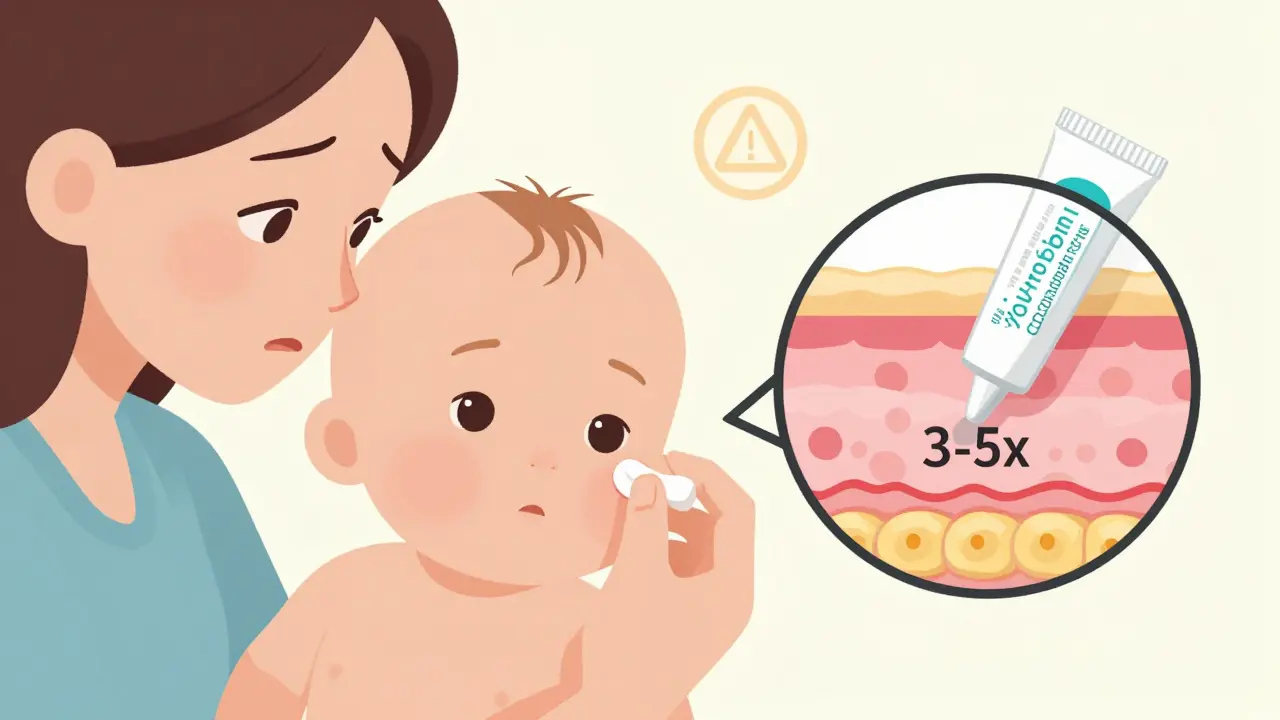
Children’s skin isn’t just smaller-it’s thinner, more porous, and less protected than adult skin. A baby’s skin barrier isn’t fully developed until around 12 months old. That means anything you put on their skin doesn’t just sit on the surface. It soaks in. Studies show that infants absorb topical medications 3 to 5 times more than adults. For kids under 1, that number can jump even higher. This isn’t a minor difference. It’s the reason why a pea-sized amount of hydrocortisone on an adult’s elbow might be fine, but on a 6-month-old’s face, it can suppress their hormone system.
And it gets worse if the skin is damaged. Eczema, diaper rash, or even a small scrape can increase absorption by up to 20 times. That’s why applying a strong cream to inflamed skin is like pouring gasoline on a fire. The medication doesn’t just treat the rash-it floods the bloodstream.
The Most Dangerous Ingredients
Not all topical products are created equal. Some are safe. Others are ticking time bombs.
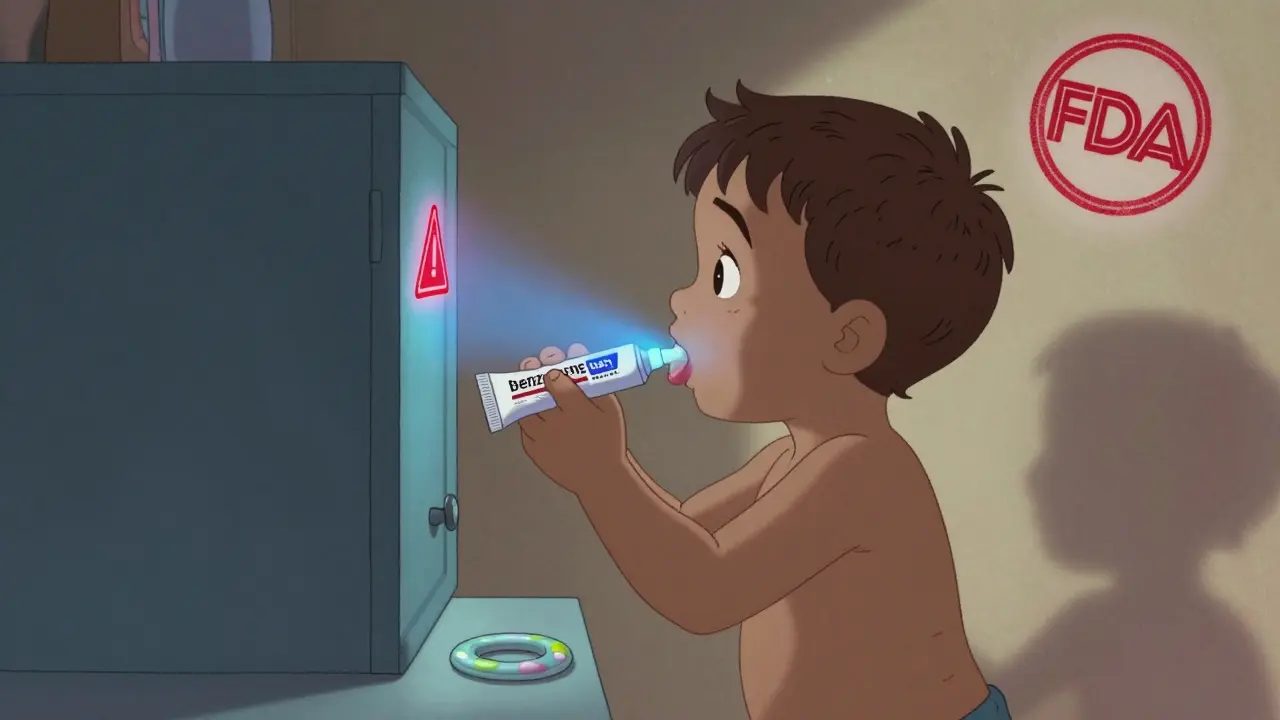
Benzocaine is one of the worst offenders. You’ll find it in teething gels, sore throat sprays, and even some sunburn lotions. The FDA banned these products for kids under 2 because they cause methemoglobinemia-a condition where the blood can’t carry oxygen properly. Symptoms show up fast: blue lips, drowsiness, trouble breathing. In some cases, oxygen levels drop below 80% in under 30 minutes. Since 2006, over 400 cases have been documented in children. The scary part? Non-pharmacological solutions like chilled rubber teethers work just as well-and carry zero risk.
Lidocaine is another common culprit. While it’s safe in controlled medical settings (like numbing a needle site), over-the-counter creams with 4% lidocaine are risky for kids. Applying too much, especially on broken skin, can lead to seizures. The safe limit for children under 3 is 1.2 grams total in 24 hours. That’s less than half a teaspoon. Most parents use way more.
Topical corticosteroids are the most commonly prescribed-and misused. A class I steroid (like clobetasol) is powerful enough to suppress the body’s natural hormone production if used too often or too widely. One study found that 15.8% of kids using high-potency steroids developed HPA axis suppression. That’s not rare. That’s common. And it’s avoidable. Low-potency options like 1% hydrocortisone are usually enough. The rule? Use the weakest cream that works, for the shortest time possible.
How Much Is Too Much?
Parents often think “more cream = faster healing.” That’s wrong. In fact, applying a thick layer doesn’t help. It just increases absorption and risk.
The gold standard for dosing is the fingertip unit (FTU). One FTU is the amount of cream squeezed from a standard tube that covers the distance from the tip of your index finger to the first crease. One FTU covers an area about the size of two adult palms. For a 10kg child, the maximum daily dose of topical steroid is 2 grams total-no more than 10% of their body surface area at once. That’s roughly 4 FTUs per day. Most families use 2 to 3 times that.
And never, ever use occlusion-like wrapping the area in plastic wrap or Tegaderm-unless your doctor specifically tells you to. Occlusion can boost absorption by 300% to 500%. In a child, that’s a recipe for overdose.
Storage and Prevention
Over 78% of accidental poisonings happen because the product was left out after use. A parent applies the cream, puts the tube down to pick up the baby, and within minutes, a toddler has the cap off and is licking the tube. That’s not hypothetical. That’s the most common scenario reported by poison control centers.
Here’s what to do:
- Always return topical medications to child-resistant packaging immediately after use.
- Store them up high, out of reach-even if you think your child can’t open it.
- Never leave creams on the bathroom counter, bedside table, or changing table.
- Check expiration dates. Old creams can break down and become more irritating or toxic.
And don’t share. Grandparents, babysitters, or relatives may use leftover prescriptions on their grandkids. That’s how a 15-month-old ends up with a potent steroid meant for an adult with psoriasis. The American Academy of Pediatrics says 19% of households share topical medications. That’s a habit that needs to stop.
Alternatives That Work
You don’t need strong chemicals to treat common skin issues.
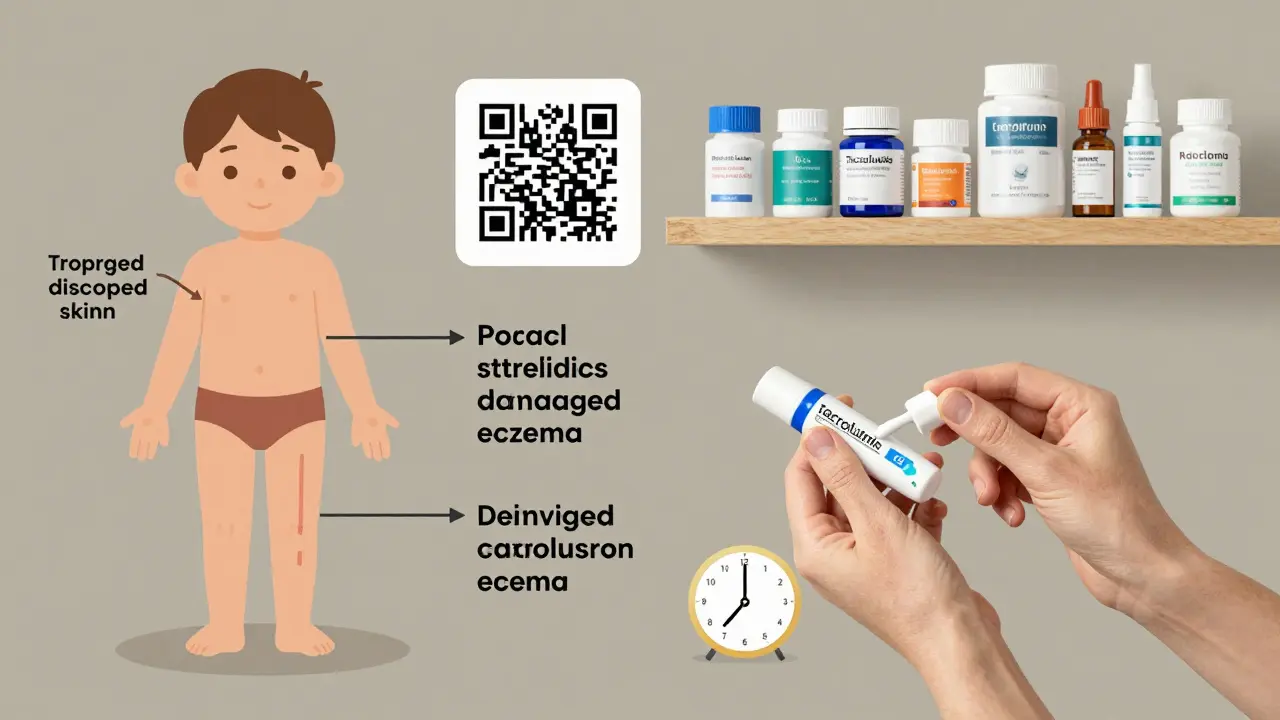
For eczema: Topical calcineurin inhibitors like tacrolimus (0.03%) or pimecrolimus are now recommended as first-line for facial rashes in kids over 3 months. They’re just as effective as low-dose steroids but cause 72% less systemic absorption. The FDA’s black box warning about cancer risk has never been proven in real-world use after 15+ years of monitoring.
For teething pain: Chilled (not frozen) teething rings, a clean wet washcloth, or gentle gum massage are safer and just as effective as benzocaine gels.
For minor cuts: Clean water, gentle soap, and a bandage. No need for antibiotic ointments unless there’s real infection risk. Most over-the-counter antibiotic creams cause more allergic reactions than they prevent.
What to Do If Something Goes Wrong
If your child shows any of these signs after applying a topical product:
- Blue or gray skin (especially lips or fingernails)
- Unusual drowsiness or confusion
- Difficulty breathing
- Seizure or tremors
Call 911 or go to the ER immediately. For benzocaine toxicity, the antidote is methylene blue-but only trained medical staff should give it. Don’t wait. Don’t try to “see if it gets better.” These reactions can be fatal within minutes.
What’s Changing in 2026
The FDA’s 2023 draft guidance is pushing for mandatory labeling changes on all topical products: clear age limits, maximum body surface area allowed, and exact duration rules. New products launching in 2025 are already using child-safe packaging with QR codes that link to age-specific dosing guides.
And research is moving fast. Nanoparticle delivery systems are in late-stage trials. These new creams deliver medication directly to the skin’s surface without soaking into the bloodstream-cutting absorption by up to 80%. They’re not on shelves yet, but they’re coming.
The bottom line? Topical medications are powerful tools-but they’re not harmless. Kids aren’t small adults. Their bodies react differently. What’s safe for you could be dangerous for them. Always check the label. Ask your pediatrician. And when in doubt, use less-not more.
Can I use hydrocortisone cream on my baby’s face?
Yes, but only if it’s 1% hydrocortisone (a low-potency steroid) and you use it sparingly-no more than 1 to 2 applications per day for up to 3 days. Avoid using it on large areas, and never apply it under occlusion. For facial eczema, topical calcineurin inhibitors like tacrolimus 0.03% are now preferred because they don’t affect hormone levels. Always check with your pediatrician first.
Is benzocaine really that dangerous for teething?
Yes. Benzocaine can cause methemoglobinemia, a rare but life-threatening condition where blood can’t carry oxygen. Symptoms appear within minutes: blue lips, lethargy, fast breathing. It’s happened to over 400 children since 2006. The FDA banned it for kids under 2 because the risk is real and the benefit is tiny. Chilled teething rings or a clean, damp washcloth work just as well without any risk.
How do I know if I’m using too much cream?
Use the fingertip unit (FTU) method. One FTU is the amount that comes out of the tube from the tip of your finger to the first crease. One FTU covers two adult palms. For most kids under 10kg, that’s 1 to 2 FTUs per day total-not per area. If you’re applying a thick layer that leaves a visible white residue, you’re using too much. Less is always better.
Can I use adult topical creams on my child?
Never. Adult formulations often contain higher concentrations of active ingredients, preservatives, or fragrances that are unsafe for children. Even if the label says "for sensitive skin," it doesn’t mean it’s safe for infants. The difference in skin thickness and metabolism means a cream that’s fine for you could cause systemic toxicity in a child. Always use products labeled for pediatric use.
What should I do if my child ingests a topical cream?
Call Poison Control immediately at 1-800-222-1222 (U.S.) or your local emergency number. Don’t wait for symptoms. Even small amounts of lidocaine, benzocaine, or potent steroids can be dangerous. Have the product container ready to give details about ingredients and concentration. Do not induce vomiting unless instructed by a medical professional.

Gretchen Rivas
Just wanted to add that topical calcineurin inhibitors like tacrolimus are way safer than steroids for facial eczema in kids. No HPA suppression, no thinning skin. I’ve used it on my 5-year-old for over a year-zero issues. Pediatric dermatologists are shifting to this as first-line now. Stop fearing the word "immunosuppressant"-it’s not what you think.
Tobias Mösl
Let’s be real-this whole post is Big Pharma fearmongering. Benzocaine? Ban it? Then why is it still in OTC products in 47 countries? They’re scared of lawsuits, not safety. My cousin’s kid used teething gel for months and turned out fine. Meanwhile, steroids are being pushed as "safe" because they’re patented and profitable. Wake up.
Divya Mallick
OMG I CAN’T BELIEVE THIS IS STILL A THING. My sister gave her 11-month-old hydrocortisone on her cheeks for 3 weeks because "it worked so well"-and now the pediatrician says she has adrenal suppression. I’m literally screaming into the void. This is why I don’t trust any doctor who doesn’t say "use the smallest amount possible" in ALL CAPS. And why are we still letting companies put 2.5% hydrocortisone in "baby" tubes?? It’s a trap. A. Trap. And don’t get me started on how they market these like candy. I saw a TikTok where a mom used a whole tube on her toddler’s back like it was lotion. I almost vomited. Someone please pass a law. I’m done.
Renee Jackson
Thank you for this incredibly thorough and evidence-based breakdown. As a pediatric nurse, I see the consequences of misinformation daily. Parents aren’t careless-they’re overwhelmed and bombarded with conflicting advice. We need clearer labeling, mandatory dosing guides on packaging, and better education in pediatric clinics. The fingertip unit method should be taught in every prenatal class. Let’s stop blaming parents and start equipping them.
Ethan Zeeb
It’s not just about dosage. It’s about culture. In my community, grandmas apply Vicks VapoRub to babies’ chests for "coughs." It’s laced with camphor and eucalyptus-both neurotoxic in infants. No one listens until someone dies. And then? Silence. We need public health campaigns that don’t sound like a medical textbook. Real talk. Real stories. Real consequences.
Lebogang kekana
I’m from South Africa and we have the same problem-parents using adult steroid creams on babies because "it’s cheaper." We lost two infants last year to adrenal crisis from topical clobetasol. It’s not a US-only issue. Global health systems need to mandate pediatric-specific packaging. And stop selling these creams next to baby shampoo in supermarkets. It’s insane.
Darren Torpey
This post is a godsend. I used to slather my son’s eczema with steroid cream like I was frosting a cake. Now? One FTU. One day. And I’ve got a calm, happy kid with zero side effects. It’s wild how much less you need when you stop overdoing it. Also-chilled washcloth for teething? Game. Changer. My baby actually slept through the night for the first time. No chemicals. Just coolness. 🙌
Jessica Chaloux
😭 I didn’t know any of this. My 8-month-old had a rash last month-I used the hydrocortisone from my medicine cabinet. I thought it was "baby strength" because the tube said "for sensitive skin." I’m so scared. Thank you for this. I’m throwing out every tube now. 😫
Mariah Carle
Isn’t it ironic? We’re told to use less, but the system rewards more. More prescriptions. More visits. More products. We’re trapped in a cycle of medicalization. The real solution? Let skin be skin. Let the body heal. The more we intervene, the more we break the natural barrier. Maybe the answer isn’t better creams-but less of them. 🤔
Megan Nayak
Let’s not pretend this is about safety. It’s about liability. The FDA didn’t ban benzocaine because kids were dying-they banned it because lawsuits were piling up. And now they’re pushing calcineurin inhibitors because they’re brand-new and patentable. Meanwhile, the real solution-better infant skin barrier research-is underfunded. This isn’t science. It’s corporate strategy dressed in white coats.
Pankaj Gupta
As someone who works in pediatric pharmacology, I appreciate the precision of this article. The fingertip unit is underutilized globally. In India, we often see parents applying entire tubes. Education is the key. We’ve piloted visual aids in rural clinics-picture cards showing one FTU next to a coin. Results improved by 68%. Simple. Visual. Effective. We need more of this.
Alex Brad
Never leave creams unattended. I learned this the hard way. My toddler got into the lidocaine cream. We rushed to the ER. They gave him activated charcoal. He’s fine. But I almost lost him because I was too lazy to put the tube away. Don’t be like me.
Chris Beckman
so u mean like if my kid has a rash i shouldnt just use my cream? like the one i use for my psoriasis? come on. i mean its the same stuff right? just less of it? also my cousin used the same cream on her baby and it worked great. why are we making this so complicated? its just lotion.
Mike Dubes
Biggest game-changer for me? Switching to fragrance-free, ceramide-rich moisturizers for eczema. No steroids. No fuss. Just daily hydration. My daughter’s skin went from raw to smooth in 3 weeks. I didn’t even need the calcineurin inhibitor. Sometimes the simplest fix is the best one. And yeah-chilled washcloth for teething? YES. My kid loves it. No chemicals. Just chill. 🥶