

For many people, statins are the go-to treatment for high cholesterol. But if you’ve tried them and ended up with muscle pain, fatigue, or other side effects, you’re not alone. About 1 in 5 people can’t tolerate statins. That’s where ezetimibe and bempedoic acid come in - two oral medications designed to lower LDL cholesterol without hitting the same muscle-related roadblocks.
How Ezetimibe Works - And When It Makes Sense
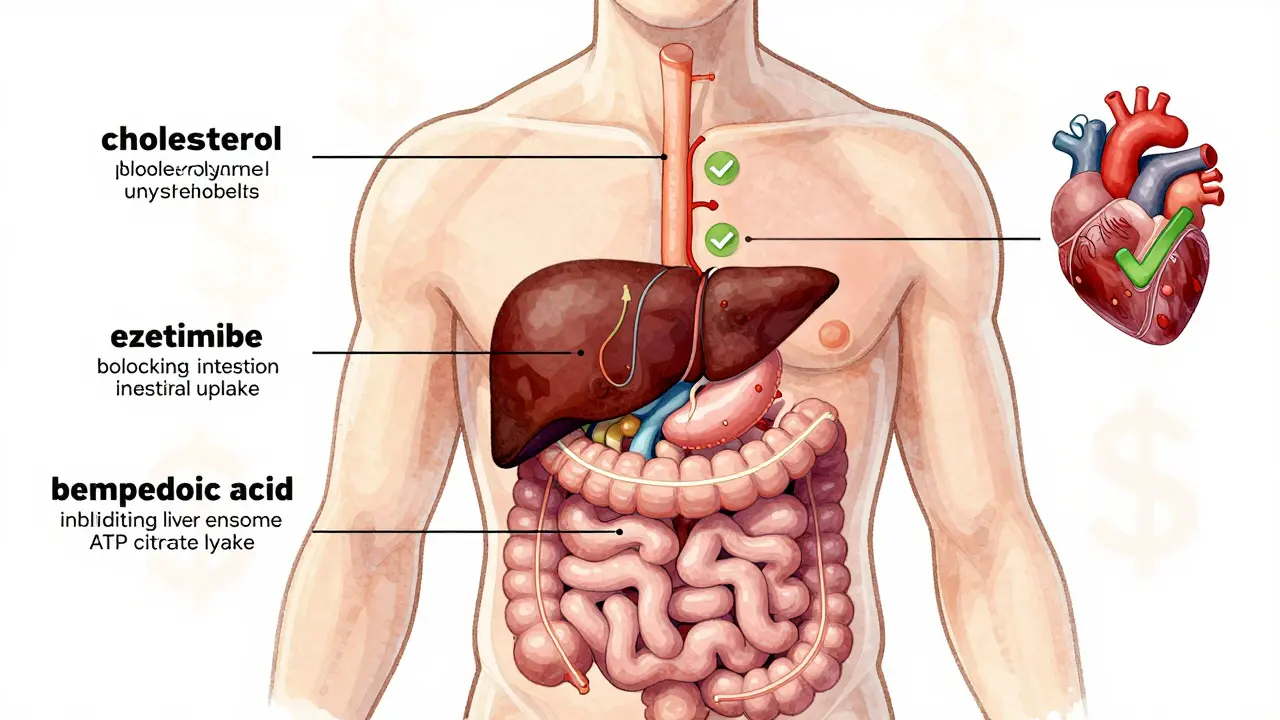
Ezetimibe, sold under the brand name Zetia, has been around since 2002. It doesn’t touch the liver like statins do. Instead, it blocks a protein in your small intestine called NPC1L1. This protein is responsible for absorbing cholesterol from the food you eat. By slowing that down, ezetimibe cuts dietary cholesterol absorption by about half. As a standalone pill, ezetimibe typically lowers LDL cholesterol by 15-22%. That’s not as strong as a statin, which can drop LDL by 30-55%. But when you combine it with a low-dose statin, it adds another 18-25% reduction. That’s why many doctors prescribe it alongside a statin that’s already been dialed back to avoid side effects. The big advantage? Cost. Generic ezetimibe costs as little as $4 a month through Medicare Part D. It’s been on the market long enough that its safety profile is well understood. Side effects are mild - mostly stomach upset or tiredness - and serious issues are rare. In real-world use, patients give it a 7.1 out of 10 on effectiveness, with many saying it’s worth it because they don’t get muscle pain.Bempedoic Acid - A New Option With Proven Heart Benefits
Bempedoic acid, marketed as Nexletol, got FDA approval in 2020. It’s a different kind of player. Instead of blocking cholesterol absorption like ezetimibe, it stops your liver from making it. It targets an enzyme called ATP citrate lyase, which works earlier in the cholesterol-making pathway than statins do. Here’s the key difference: bempedoic acid is a prodrug. That means it only becomes active in the liver, where the enzyme needed to activate it is found. Skeletal muscle doesn’t have that enzyme. So, unlike statins, it doesn’t build up in your muscles - which is why muscle pain is so much less common. In clinical trials, bempedoic acid lowered LDL by 17-23% on its own. When paired with ezetimibe (as Nexlizet), that jumps to 35-40%. But more importantly, the CLEAR Outcomes trial - a massive study of nearly 14,000 people with heart disease who couldn’t take statins - showed it cut major heart events like heart attacks and strokes by 13% over 3.5 years. That’s not just about lowering numbers; it’s about saving lives.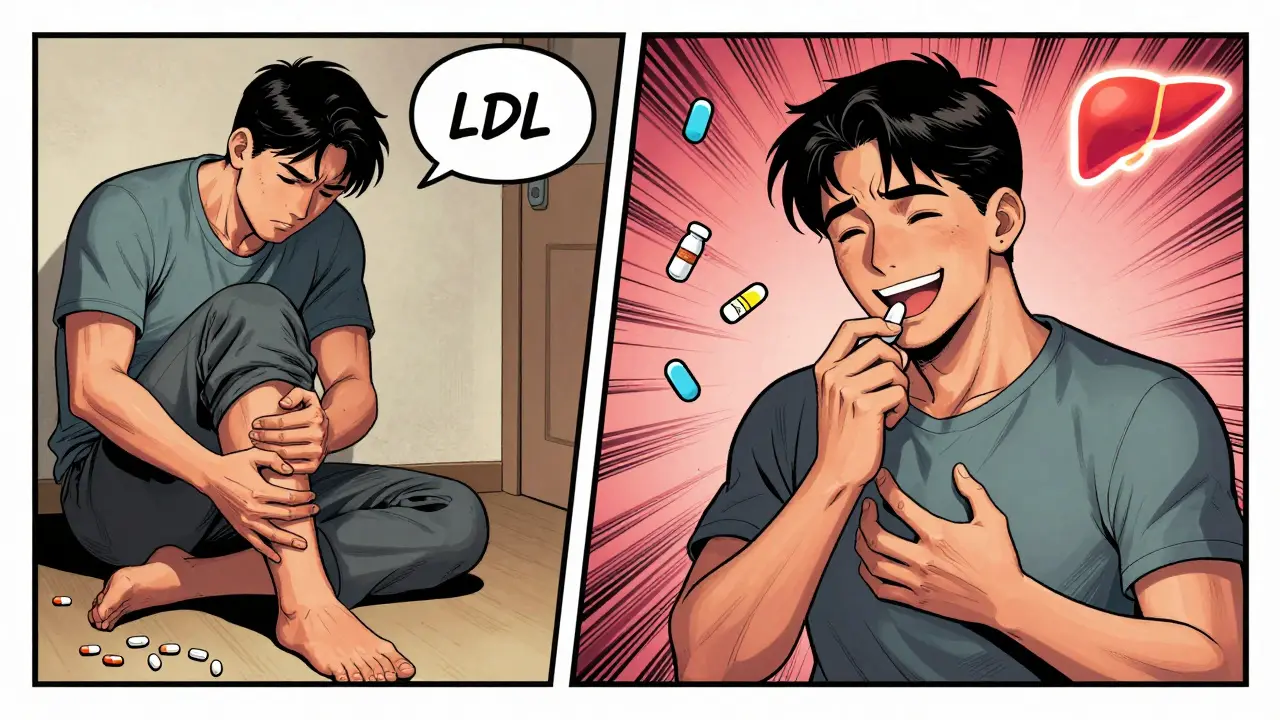
How They Compare to Statins and Other Drugs
Let’s be clear: statins still win on power. High-dose atorvastatin or rosuvastatin can slash LDL by over 50%. That’s why they’re first-line. But for people who can’t take them, alternatives matter. Here’s how these three stack up:| Medication | LDL Reduction (Monotherapy) | Route | Cost (Monthly, US) | Key Risk |
|---|---|---|---|---|
| High-Intensity Statin (e.g., atorvastatin 40-80 mg) | 50-55% | Oral | $0.20-$1.00 | Muscle pain (5-10%) |
| Ezetimibe | 15-22% | Oral | $4 | Mild GI upset |
| Bempedoic Acid | 17-23% | Oral | $231* | Tendon rupture (0.5%), joint pain |
| Bempedoic Acid + Ezetimibe (Nexlizet) | 35-40% | Oral | $400+ | Combined risks |
| PCSK9 Inhibitors (e.g., Repatha, Praluent) | 50-60% | Injection (every 2-4 weeks) | $500-$700 | Injection site reactions |
*Price with GoodRx discount; may be higher without insurance.
Compared to PCSK9 inhibitors - which are injectables and cost over $500 a month - bempedoic acid and ezetimibe are easier to take and cheaper. But they’re not as powerful. Still, for someone who can’t tolerate statins and doesn’t want needles, this is a real option.
Who Should Consider These Medications?
These aren’t for everyone. Doctors usually recommend them in two cases:- You’ve tried at least two different statins at different doses and still had muscle pain, weakness, or cramps that didn’t go away.
- You’re on the highest tolerated statin dose but still haven’t hit your LDL target (usually below 70 mg/dL if you’ve had a heart attack or have diabetes).
Before jumping to alternatives, your doctor should confirm true statin intolerance. That means ruling out other causes of muscle pain - like thyroid issues or vitamin D deficiency - and trying a rechallenge with a different statin, maybe at a lower dose.
For bempedoic acid, there are a few red flags. It’s not safe if you have severe kidney disease (eGFR below 30). It also shouldn’t be mixed with high doses of simvastatin (over 20 mg) or pravastatin (over 40 mg) because it can increase their levels in your blood. If you’re on rosuvastatin, your dose may need to be lowered.
Real People, Real Results
Patient stories tell the real story. On Reddit, one user switched from atorvastatin to bempedoic acid after muscle pain made daily walks impossible. Six months later, their LDL dropped from 142 to 101 - no pain, no fatigue. They called it a game-changer. Another user tried ezetimibe alone after statins failed. Their LDL dropped by 18 points. They said it barely moved the needle and wasn’t worth the copay. The data backs this up. On GoodRx, 42% of people say bempedoic acid worked for them. But 76% complain about the cost. On PatientsLikeMe, ezetimibe scores higher in satisfaction than bempedoic acid - mostly because it’s cheap and predictable. Bempedoic acid does come with a small risk of tendon problems. In trials, 0.5% of users had tendon ruptures - mostly in the Achilles. That’s rare, but it’s why the FDA requires a special safety program for it. Joint pain also showed up more often in real life (12%) than in clinical trials (2%), suggesting some side effects are underreported.What’s Next? The Future of Non-Statin Therapy
The approval of Nexlizet - the combo of bempedoic acid and ezetimibe - was a big step. It gives doctors a single-pill option for patients who need stronger LDL lowering without statins. New studies are already underway. The CLEAR CardioTrack trial, expected to finish in late 2025, is using ultrasound to see if bempedoic acid actually shrinks plaque in arteries. Early signs are promising. Meanwhile, ezetimibe’s market share is slowly shrinking as generics flood the market. Bempedoic acid, despite its price, is gaining ground. Analysts predict it could become the go-to oral alternative for statin-intolerant patients by 2027. The bottom line? Statins still save the most lives. But for those who can’t take them, we now have two solid, evidence-backed options. Ezetimibe is the affordable, low-risk starter. Bempedoic acid is the more powerful, outcome-proven choice - if you can afford it.It’s not about finding the perfect drug. It’s about finding the one that lets you live without pain - and still protect your heart.
Can I take ezetimibe or bempedoic acid instead of a statin?
Yes - but only if you can’t tolerate statins or if you’re on the highest tolerated dose and still not at your LDL goal. These are second-line options. Statins are still the first choice because they’re more effective and cheaper. Never stop a statin without talking to your doctor.
Which is better: ezetimibe or bempedoic acid?
It depends. If cost is your main concern and you only need a modest LDL drop, ezetimibe is the clear winner. If you’ve tried ezetimibe and still aren’t at goal, or if you have heart disease and need stronger protection, bempedoic acid has proven benefits for reducing heart attacks and strokes. Bempedoic acid is more powerful and outcome-proven, but also more expensive.
Do these medications cause muscle pain like statins?
Ezetimibe rarely causes muscle pain. Bempedoic acid causes muscle pain at rates similar to placebo (about 5%) because it’s activated only in the liver, not in muscles. This is its biggest advantage over statins. However, bempedoic acid can cause joint pain and, rarely, tendon issues - so report any new pain in your shoulders, knees, or heels.
How long does it take to see results?
You’ll usually see your LDL levels drop within 2-4 weeks. Doctors typically check your lipid panel at 4-12 weeks to see how well it’s working. For bempedoic acid, a 15% or greater drop is considered a good response. Ezetimibe should lower LDL by at least 10%.
Is bempedoic acid covered by insurance?
It depends. Many insurance plans cover it, but often require prior authorization proving you’re statin-intolerant. Medicare Part D usually covers it, but you may pay over $100 a month without discounts. GoodRx coupons can bring the price down to around $231/month. Always check with your pharmacy before starting.
Can I take these with other heart medications?
Yes, but with caution. Bempedoic acid can increase levels of certain statins like simvastatin and rosuvastatin, so your doctor may need to lower those doses. It’s generally safe with blood pressure meds, aspirin, or diabetes drugs. Always tell your doctor and pharmacist about every medication you take - even over-the-counter ones.


Darren McGuff
Just switched to bempedoic acid last month after statins turned me into a walking limp. My LDL dropped from 158 to 99 in 6 weeks-no muscle agony, no fatigue. I can finally walk my dog without feeling like I’ve been hit by a truck. The price? Ouch. But my cardiologist says if it cuts my heart attack risk, it’s worth every penny. Also, my tendon’s fine… so far.
PS: If you’re on simvastatin, DO NOT combine without checking with your doc. I nearly did and my pharmacist nearly had a heart attack.
Ashley Kronenwetter
While I appreciate the detailed breakdown, it’s important to emphasize that ezetimibe and bempedoic acid are not first-line therapies. They are adjuncts or alternatives for patients with documented statin intolerance, which must be clinically verified. Misuse of these agents as primary therapy in statin-tolerant individuals could lead to suboptimal outcomes and increased healthcare costs. Always consult with a lipid specialist before de-escalating from guideline-recommended care.
Heather Wilson
Let’s be real-this whole post reads like a pharma ad. Bempedoic acid has a 0.5% tendon rupture rate? That’s not rare, that’s terrifying. And why is no one talking about how the CLEAR Outcomes trial was funded by the manufacturer? Also, ezetimibe? 18-point drop? That’s barely a blip. If your LDL is still over 100 after six months, you’re not ‘managing’ it-you’re just delaying the inevitable. And don’t get me started on the cost. $400 a month for a pill that doesn’t even cut heart attacks in half? We’re treating symptoms, not causes. Lifestyle changes would’ve saved you $4800 a year and given you more energy than this drug cocktail ever could.
Jeffrey Hu
Guys, you’re all missing the point. Bempedoic acid isn’t magic-it’s just a clever workaround. Statins inhibit HMG-CoA reductase. Bempedoic acid hits ATP citrate lyase upstream. Same pathway, different enzyme. That’s why it doesn’t wreck your muscles. But here’s the kicker: it still increases uric acid, which means gout risk goes up. And yes, tendon rupture is real-I saw two cases in my clinic last year. One guy tore his Achilles lifting groceries. Also, the combo pill Nexlizet? It’s just a pill that costs $400 because they slapped two generics together and called it innovation. Classic pharma move. Bottom line: ezetimibe for budget, bempedoic acid for high-risk patients. But if you’re not exercising or eating real food, none of this matters.
Matthew Maxwell
It’s irresponsible to promote these drugs as viable alternatives without stressing that statins are the gold standard for a reason-they reduce mortality. You’re not just lowering LDL numbers-you’re saving lives. People who reject statins for ‘muscle pain’ often have vitamin D deficiency, hypothyroidism, or just don’t want to take medication. This post reads like a seductive lie wrapped in data. If you can’t tolerate statins, try a different one. Or lower the dose. Or take coenzyme Q10. But don’t just jump to expensive, poorly studied alternatives because you’re lazy. Heart disease doesn’t care about your convenience.
Angela Stanton
OMG I’m so glad this post exists!! 😭 I’ve been on Nexlizet for 3 months and my LDL dropped from 180 to 87!! 🙌 No muscle pain, no fatigue, just vibes. My doc said I’m ‘low risk’ now-finally! 💪 But yeah, the cost is wild. I used GoodRx and got it for $199/month… still feels like paying for a Tesla but at least I can breathe again. Also, joint pain? Totally real. My knees feel like they’re made of sandpaper now… but I’d rather have creaky joints than a heart attack. #BempedoicAcidSavior #CardioLifeSaved 🩺❤️
Kiruthiga Udayakumar
Why are we even talking about pills? In India, we’ve been managing cholesterol for generations with turmeric, garlic, fenugreek, and daily walks. No drugs. No $400 pills. Just real food and real movement. You people are so addicted to pills you forget your body knows how to heal itself. Ezetimibe? Bempedoic acid? These are Band-Aids on a bullet wound. Stop treating symptoms. Fix your diet. Stop sugar. Stop processed junk. Then come back and tell me you still need these drugs.
Patty Walters
just wanted to say ezetimibe worked for me-ldl dropped 20 points, no side effects, and i pay $3 a month. bempedoic acid sounded great until i saw the tendon thing. i’m not risking a ruptured achilles for 10 extra points. also, if you’re on statins and have muscle pain, try coq10 first. i did, and my cramps vanished. also, drink more water. and walk. it’s not rocket science. 🙃