
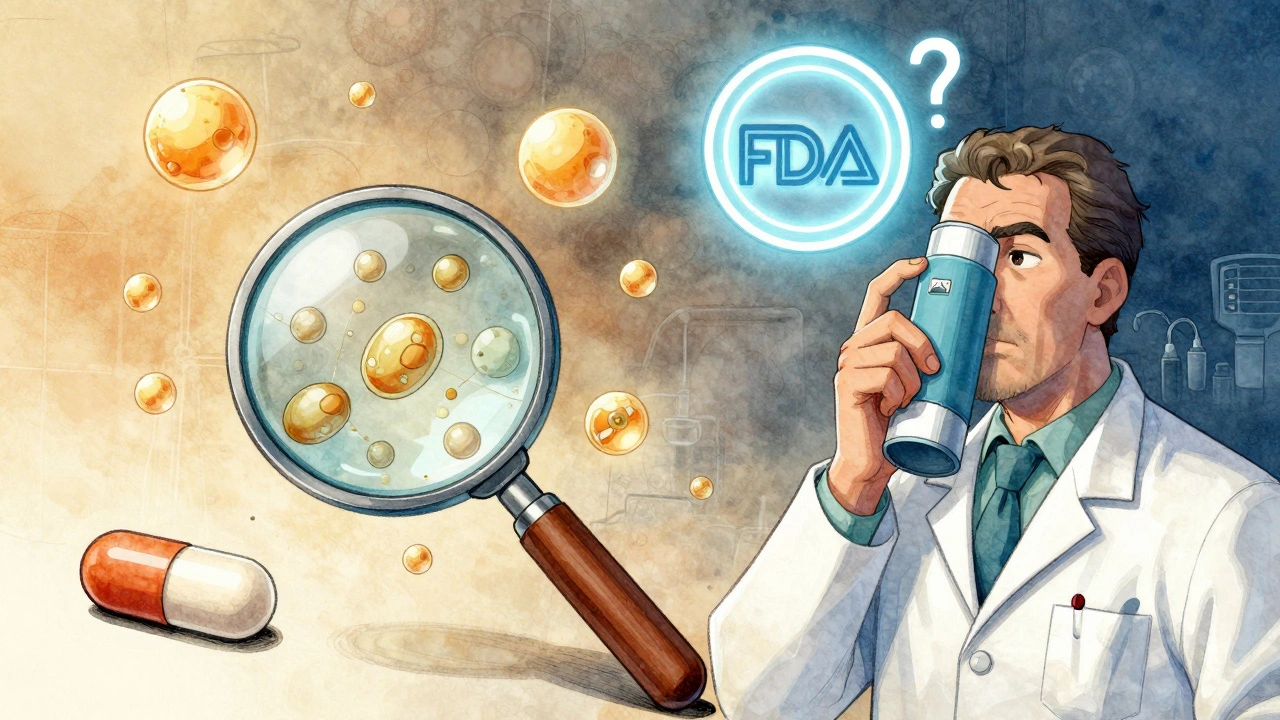
Not all generic drugs are created equal. While most generic pills are simple copies of brand-name drugs - same active ingredient, same dose, same pill shape - a growing group of generics are anything but simple. These are complex generic drugs: liposomal injections, long-acting injectables, inhalers with precise device mechanics, and peptide-based therapies. They’re designed to treat serious conditions like chronic pain, cancer, and asthma. But getting them approved by the FDA? That’s where things get messy.
Why complexity breaks the generic formula
The FDA’s standard path for approving generics - the Abbreviated New Drug Application, or ANDA - was built for straightforward drugs. If a generic company can prove their pill dissolves the same way and gets into the bloodstream at the same rate as the brand-name version, they get approval. Simple. But complex generics don’t work that way. Take a liposomal injectable, like the generic version of bupivacaine approved in 2019. The drug isn’t just floating in liquid; it’s trapped inside tiny fat bubbles designed to release slowly over days. To prove it works like the brand, you can’t just measure blood levels. You have to show the fat bubbles behave the same way - how they form, how they break down, how they deliver the drug over time. That’s not a lab test. That’s a whole new science. Same with inhalers. Even if the drug inside is identical, if the inhaler’s nozzle is 0.1 millimeters wider than the original, the drug particles might land differently in the lungs. The FDA can’t ignore that. Patients don’t feel the difference, but the agency has to treat it like a different drug. That’s why some inhaler generics sit in review for years - not because the drug is unsafe, but because the device doesn’t match perfectly.The science behind the delays
Developing a complex generic isn’t just harder - it’s more expensive and takes longer. A typical generic drug might cost $5 million and take two years to develop. A complex one? $20 to $50 million. And five to seven years. Why?- Formulation challenges: Replicating a liposome or a polymer matrix requires exact control over temperature, pressure, and mixing speed. Tiny changes change the drug’s behavior.
- Analytical challenges: Standard tests can’t measure these products. Labs need advanced tools like cryo-electron microscopy and high-resolution mass spectrometry just to see what’s in the drug.
- Clinical challenges: For long-acting injectables, you can’t just give one dose and check blood levels. You need weeks or months of monitoring to track how the drug releases - and that means more patients, more visits, more cost.
- Regulatory uncertainty: Without clear FDA guidance, companies guess what’s needed. One company might submit a 500-page application. The FDA might say, “We need more data on particle size distribution.” So they go back. And back. And back.
A 2023 review of 24 global studies found that analytical and regulatory issues were the top two hurdles - cited in nearly every paper. The FDA doesn’t have a playbook for every complex product. So each submission becomes a negotiation.
Regulatory pathways that don’t fit
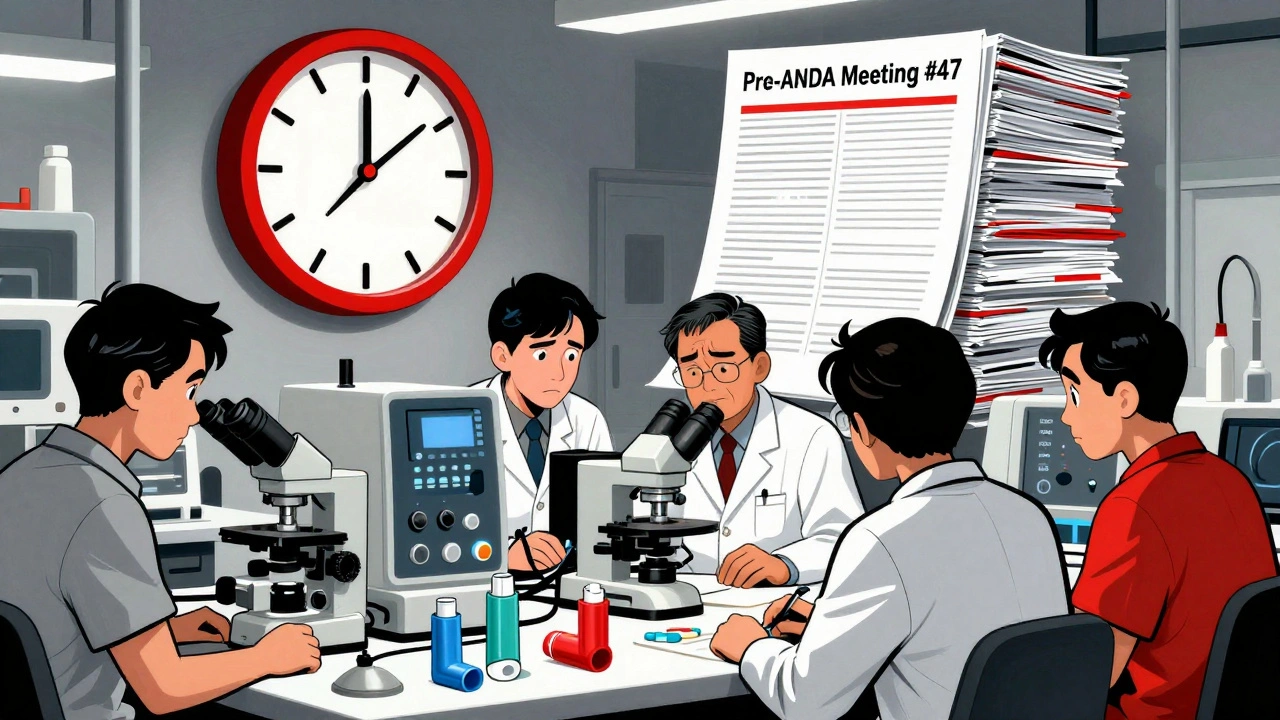
The ANDA pathway was never meant for this. For many complex generics, the only realistic path is the 505(b)(2) application - a hybrid route originally designed for slightly modified brand drugs. It’s slower, more expensive, and requires new clinical data. That defeats the whole purpose of generics: to be fast, cheap alternatives. The FDA tried to fix this with GDUFA II in 2017, adding special review tracks for complex products. They created the Pre-ANDA Meeting Program, where companies can sit down with FDA scientists before submitting an application. By 2023, over 1,200 of these meetings had been held. That’s progress. But it’s not enough.Even with meetings, companies still face unclear expectations. One generic manufacturer told regulators: “We spent three years building a device that matches the brand. Then you asked for a new test we didn’t know existed.” That kind of surprise kills momentum.
Guidance documents - the missing map
The FDA has published over 1,700 Product-Specific Guidances (PSGs) - detailed instructions on how to approve specific drugs. For complex generics, these are critical. A PSG might say: “For this liposomal product, use dynamic light scattering to measure particle size, and demonstrate bioequivalence through a 14-day pharmacokinetic study.” Without that, companies are flying blind. But here’s the problem: only about 160 of those 1,700 PSGs are for complex products. And many were written years ago. New formulations keep popping up - like peptide-based patches or nanoparticle creams - and there’s no guidance for them. So companies wait. Patients wait. And the FDA gets more applications than they can handle.Why so few approvals - and why it matters
Since 2015, the FDA has approved just 15 complex generic drugs. In the same period, over 1,000 conventional generics got through. That’s not a coincidence. It’s a system built for simplicity. This isn’t just a regulatory issue - it’s a patient issue. Complex generics often replace expensive brand drugs that cost $10,000 a year. If a generic version takes five years to get approved, patients pay more. Hospitals pay more. Insurance pays more. The Congressional Research Service found that while the FDA has improved its overall approval times since 2012, complex products still take nearly twice as long as simple ones. And many never make it. One company spent $40 million and six years trying to get a complex inhaler approved. They withdrew the application because the FDA kept changing its requirements.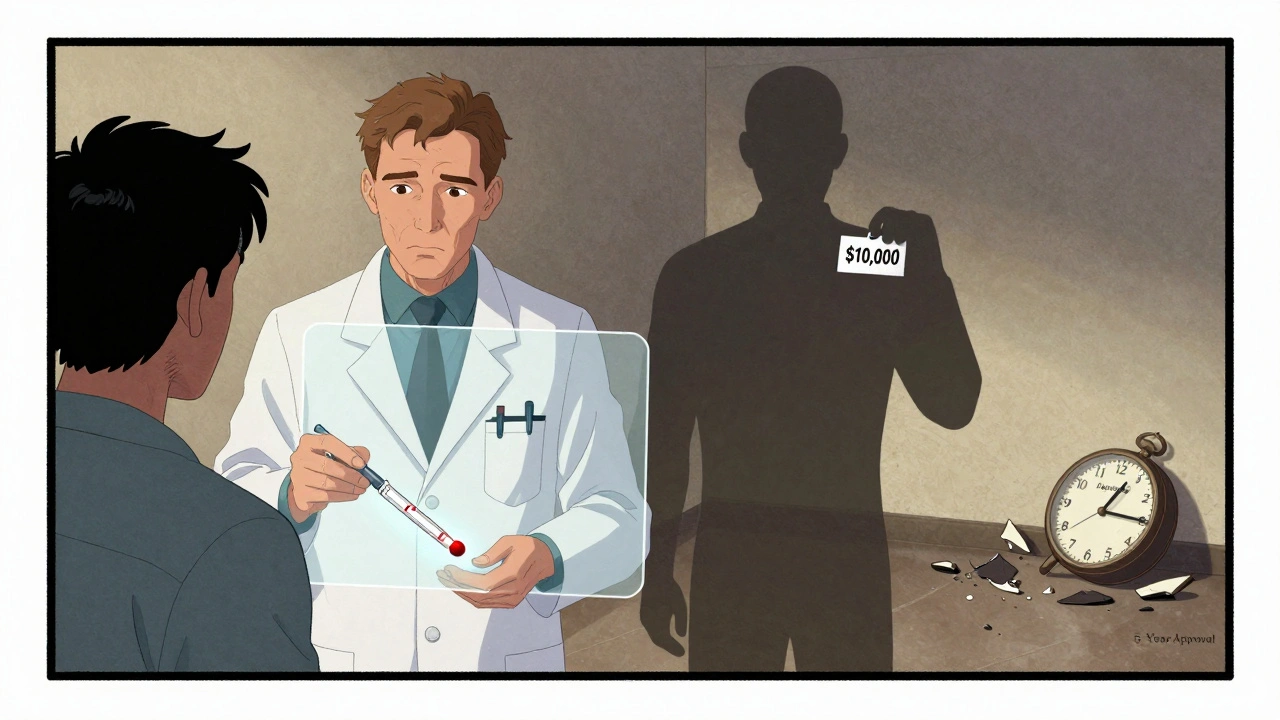
What’s changing - and what’s not
The FDA knows this is a problem. In 2023, they promised to review most original generic applications within 10 months. They hired 128 new reviewers. They’re investing in AI tools to predict how a drug will behave in the body. They’re testing machine learning models to analyze nanoparticle behavior faster. Some progress is visible. The 2019 approval of the generic bupivacaine liposome was a milestone. It showed that with clear guidance, good science, and close collaboration, complex generics can get approved. But that case took years of back-and-forth. It shouldn’t have to be that hard. Industry experts believe AI and quality-by-design approaches could cut development time by 20-30% by 2027. But until the FDA publishes more targeted guidance and sticks to it, companies will keep spending millions on dead-end applications.What’s next for complex generics
The market is ready. By 2028, complex generics could make up 25% of the $250 billion global generic drug market. That’s because dozens of expensive brand-name drugs - like long-acting insulin, cancer therapies, and pain treatments - are losing patent protection. But if the approval process doesn’t catch up, those drugs will stay expensive. Big pharmaceutical companies will keep their monopoly. Patients will keep paying more. The solution isn’t more bureaucracy. It’s clarity. Consistency. And faster science. The FDA has the tools. They’ve shown they can do it - with bupivacaine, with a few inhalers, with a handful of others. Now they need to do it at scale.Generic drugs were supposed to bring down prices. Complex generics were supposed to do the same for the most expensive treatments. But right now, the system is broken. And the people who lose are the ones who need these drugs the most.
Why are complex generic drugs harder to approve than regular generics?
Complex generics have ingredients or delivery systems that are harder to replicate - like liposomes, long-acting injectables, or inhalers with precise device mechanics. Unlike simple pills, you can’t just measure blood levels to prove they work the same. You need advanced testing, detailed device matching, and often new clinical studies. The FDA’s standard approval path (ANDA) wasn’t built for this, so each application becomes a unique scientific challenge.
What’s the difference between an ANDA and a 505(b)(2) application?
An ANDA is the standard path for generics - you prove your drug is bioequivalent to the brand without doing new clinical trials. A 505(b)(2) application is a hybrid route that lets you rely partly on the brand’s data but requires new studies - often clinical - to prove safety or effectiveness for changes in formulation, delivery, or dosing. For complex generics, 505(b)(2) is often the only option, but it’s slower and more expensive, which defeats the purpose of generics.
How many complex generic drugs have been approved by the FDA?
Since 2015, the FDA has approved only about 15 complex generic drugs. In contrast, over 1,000 conventional generics were approved in the same period. This gap exists because complex products face scientific, technical, and regulatory hurdles that slow down or block approval - even when the drug is safe and effective.
Why do inhaler generics take so long to get approved?
Even tiny differences in the inhaler device - like nozzle size, airflow pattern, or valve timing - can change how much drug reaches the lungs. The FDA treats the device as part of the drug, so it must match the brand exactly. Minor changes that patients wouldn’t notice can trigger major regulatory delays. Companies spend years redesigning devices just to meet these standards.
Is the FDA doing anything to speed up approval of complex generics?
Yes. Since 2017, the FDA has expanded its Pre-ANDA Meeting Program, holding over 1,200 meetings to help companies understand requirements. They’ve published over 200 new Product-Specific Guidances since 2022. They’re also hiring more reviewers and using AI to analyze complex data faster. But progress is slow - guidance still lags behind new drug technologies, and expectations can shift during review.
What’s the financial impact of delays in complex generic approvals?
Developing a complex generic can cost $20-50 million and take 5-7 years - compared to $5 million and 2-3 years for a regular generic. Many companies abandon projects because of regulatory uncertainty. That means fewer affordable options for patients. For drugs that cost $10,000 a year, delays mean patients pay more for longer - and insurers and hospitals pay the difference.
Will AI help speed up complex generic approvals?
Yes, but not yet. AI and machine learning are being tested to predict how nanoparticles or liposomes behave in the body, reducing the need for lengthy clinical trials. Quality-by-design approaches - where products are built with consistent quality from the start - could cut review times by 35-45%. Industry analysts predict AI will reduce development time by 20-30% by 2027. But these tools need more validation and FDA acceptance before they become standard.


Brian Perry
bro this is wild like i had no idea a simple inhaler could take 5 years to approve?? like i get it’s science but come onnnn 😭
Stacy Natanielle
The regulatory inefficiencies surrounding complex generic drug approval represent a systemic failure in translational science policy. The FDA's adherence to archaic bioequivalence paradigms, despite the advent of nanotechnology and precision delivery systems, constitutes a profound misalignment between regulatory infrastructure and contemporary pharmaceutical innovation. This is not merely bureaucratic delay-it is a public health crisis masked as procedural rigor.
Moreover, the reliance on 505(b)(2) pathways for products that are functionally generic undermines the economic rationale for generic market entry. The resulting financial burden on manufacturers, coupled with the absence of standardized analytical frameworks, creates a chilling effect on R&D investment. In essence, the system disincentivizes competition where it is most needed.
AI-driven predictive modeling for particle behavior and lipid bilayer dynamics could reduce development timelines by 30–40%... yet the FDA continues to treat these tools as experimental rather than foundational. This is not innovation-it is institutional inertia.
📊 Data point: The 15 complex generics approved since 2015 represent < 0.5% of total generic approvals. The cost differential between brand and generic for liposomal bupivacaine is $8,000 vs. $1,200 per dose. The delay? 7 years. That’s $2.1 billion in excess healthcare spending. Just for one drug.
📉 Conclusion: Regulatory modernization is not optional. It is an ethical imperative.
kelly mckeown
i just keep thinking about the people waiting for these drugs… like, someone’s grandma might be in pain and can’t afford the brand, and the generic is stuck in review for years. it’s not just about money or science-it’s about people. i wish the FDA could just say, ‘here’s what we need’ and stick to it instead of making companies guess. it’s exhausting for everyone.
Tom Costello
Interesting breakdown. One thing often missed is how global regulators handle this differently. The EMA has more flexible guidance for complex generics-especially inhalers-and they’ve approved several that the FDA hasn’t. It’s not that the science is harder overseas; it’s that the FDA’s internal culture is more risk-averse. The Pre-ANDA meetings help, but they’re still optional, and many small companies can’t afford to fly to DC for them.
Also, the fact that a 0.1mm nozzle difference triggers a full re-evaluation says more about our obsession with control than patient outcomes. If the drug works and the device delivers it safely, why not accept some variability? We don’t do that with insulin pens or nebulizers.
dylan dowsett
Wait-so the FDA is letting companies spend $50 million… and then just… changes the rules?? That’s not regulation. That’s emotional manipulation. They’re playing games with people’s livelihoods. And don’t even get me started on how they cherry-pick which drugs get guidance and which get ignored. This isn’t science-it’s a power play. And patients? They’re collateral damage. 💔
Akash Sharma
As someone from India who’s seen generic drugs change lives here, this hits hard. In our country, we make complex generics too-like liposomal amphotericin for fungal infections-and we’ve had to build our own testing labs because the global standards were too vague. We don’t have the FDA’s budget, but we’ve learned to be more agile. The real problem isn’t the science-it’s the lack of global alignment. Why can’t the FDA collaborate with WHO or EMA to create shared standards? Why reinvent the wheel every time? I’ve read papers where Indian labs used cheaper, faster methods that matched FDA results… but the FDA still demanded their own $500k equipment. That’s not science-it’s protectionism disguised as safety.
Also, the mention of AI is great, but no one talks about open-source datasets. If the FDA released anonymized data from past complex generic applications (with IP protected), startups could train models to predict approval success. Instead, everything’s locked behind NDAs. It’s like hoarding knowledge while people suffer.
And let’s not forget: many of these complex drugs were invented in academia. The patent expiry should be a gift to humanity-not a bureaucratic labyrinth.
Wendy Chiridza
the fact that they need cryo-EM just to see what’s in the drug is wild. we’re talking about life-saving meds and the tools to test them cost more than a house. how is that fair? the system is broken and everyone knows it. why aren’t we fixing it?
Palanivelu Sivanathan
you know what this is? it’s capitalism playing dress-up as science. the FDA is the priest of the pharmaceutical religion, and the complex generics? they’re heretics. they don’t bow to the old rituals. they don’t fit the dogma. so they’re cast out. meanwhile, the brand-name giants sit in their ivory towers sipping champagne, laughing as patients go bankrupt. the real drug isn’t in the vial-it’s in the policy. and that policy? it’s designed to keep the rich rich and the sick… silent.
we’re not fighting over pill shapes. we’re fighting over who gets to live.
Adrianna Alfano
my dad’s on a long-acting injectable for chronic pain. the brand costs $12k a year. the generic? been in review since 2020. he’s been using coupons, skipping doses, crying in the pharmacy. i’ve read every damn study on this. the science is there. the FDA just doesn’t want to admit they’re behind. they’re scared of being wrong. so they make us suffer. and they call it ‘caution.’ it’s cowardice.
Casey Lyn Keller
so… the FDA hires 128 new reviewers… but still can’t approve a liposome? sounds like they just hired a bunch of interns to file papers. i bet they’re still using fax machines for some of this. someone’s getting paid to do nothing. this whole thing is a joke.
Jessica Ainscough
thank you for writing this. i’ve been working in a clinic and seeing patients skip meds because they can’t afford the brand. it’s heartbreaking. if we can make a generic for a $10k drug, why does it take 7 years? i just hope someone listens before more people get hurt.
May .
so the FDA’s slow and expensive and the patients pay the price