
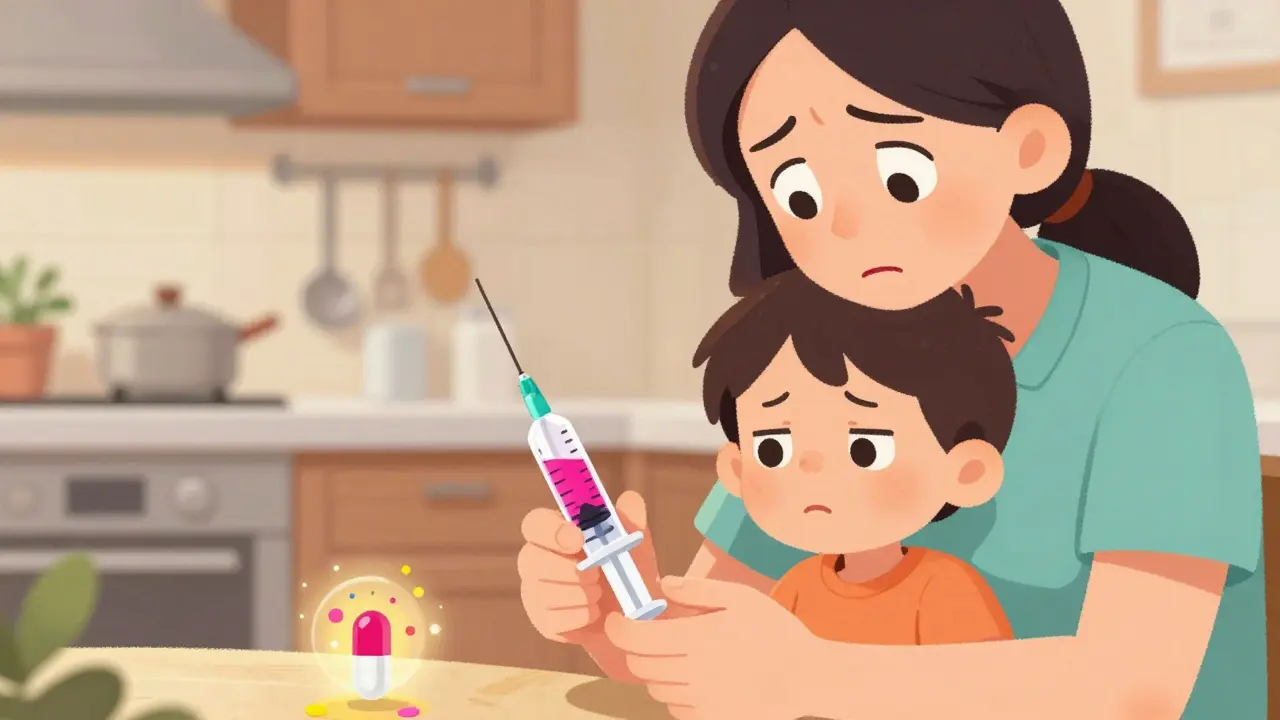
When your child is sick, the last thing you want is a battle over medicine. You’ve got two options: a sweet-tasting liquid or a tiny pill. One seems easier. The other seems safer. But which one actually works better? The truth is, it’s not as simple as what you’ve been told. For years, doctors and parents assumed liquids were the only safe choice for kids. But that’s changing - fast.
Why Liquids Used to Be the Default
It makes sense why liquids became standard. Infants can’t swallow pills. Toddlers spit out anything bitter. So doctors reached for the syringe. But here’s what most people don’t know: liquid medications aren’t always better. In fact, they’re often the harder choice.
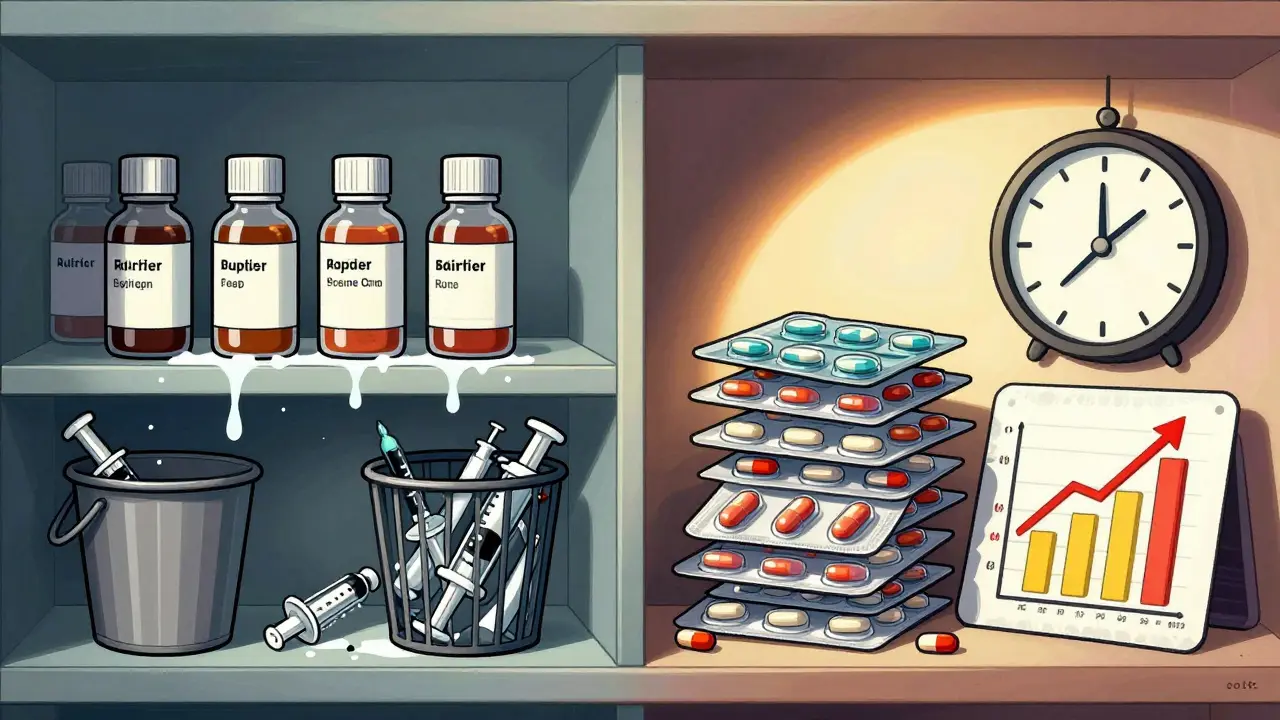
Let’s break it down. Liquids are flexible. You can give 2.5 mL or 4.8 mL - perfect for dosing by weight. For babies under 6 months, that’s still the gold standard. But for older kids? The downsides pile up. Many liquid medicines need refrigeration. They expire in 14 to 30 days after opening. And if you leave them on the counter? They can go bad before you finish the bottle.
Then there’s the taste. A 2007 study found that 68% of kids refuse liquid meds because they taste like chemicals, not fruit. Strawberry-flavored doesn’t mean it tastes like real strawberries. It means it tastes like a lab experiment gone wrong. One parent on Reddit put it bluntly: "My 4-year-old would rather swallow a mini-tablet than take the ‘strawberry’ antibiotic that tasted like chemicals."
And here’s the kicker - measurement errors. The FDA found that 12 to 18% of parents give the wrong dose of liquid medicine. Why? Because measuring cups, spoons, and syringes are confusing. A teaspoon isn’t a tablespoon. A syringe marked in mL doesn’t match the label in mg. It’s easy to mess up. And when you’re tired, stressed, or in the middle of the night? Mistakes happen.
The Rise of the Mini-Tablet
Fast forward to today. The game has changed. Thanks to new technology, we now have mini-tablets as small as 2mm wide - smaller than a pea. These aren’t crushed pills. They’re specially made for kids. Coated to hide bitterness. Designed to dissolve in 30 seconds. Some even come in flavors that actually taste like fruit.
A 2012 study tracked 60 kids aged 6 months to 6 years. The results? Kids as young as 1 year old swallowed mini-tablets just as easily as liquids. In fact, refusal rates dropped from 40% with liquids to just 15% with solids. Why? Because kids don’t hate swallowing - they hate the taste and the mess.
Modern pediatric tablets also solve another problem: stability. Liquid antibiotics can lose potency in just a few weeks. Tablets? They last 2 to 3 years on the shelf. No refrigeration. No spills. No waste. One UK study found that switching just one child’s liquid prescription to a tablet could save £1.50 per dose. Multiply that by thousands of prescriptions - hospitals save tens of thousands a year.
When Liquids Still Win
Don’t get me wrong - liquids aren’t obsolete. For newborns, infants under 6 months, or kids who can’t swallow at all, they’re still essential. And for certain medications, like levothyroxine or warfarin, where even a 5% dose difference can cause problems, liquids offer precision you can’t get with a tablet.
Also, if your child is vomiting, has a sore throat, or can’t keep anything down, a liquid might be the only way to get the medicine in. But for most common infections - ear infections, strep throat, sinusitis - a tablet works just as well.
Here’s the rule of thumb: if the medicine has a wide safety range (like most antibiotics), go solid. If it’s narrow (like thyroid meds or seizure drugs), stick with liquid.
Swallowing Tablets: It’s a Skill
The biggest fear parents have? Choking. But here’s the data: from 2010 to 2020, the FDA recorded fewer than 0.002% of pediatric tablet doses resulted in choking. That’s less than 1 in 50,000. Far safer than the risk of giving the wrong dose with a syringe.
So why do so many parents avoid tablets? Because they’ve never been taught how to help their child learn. It’s not about forcing. It’s about training.
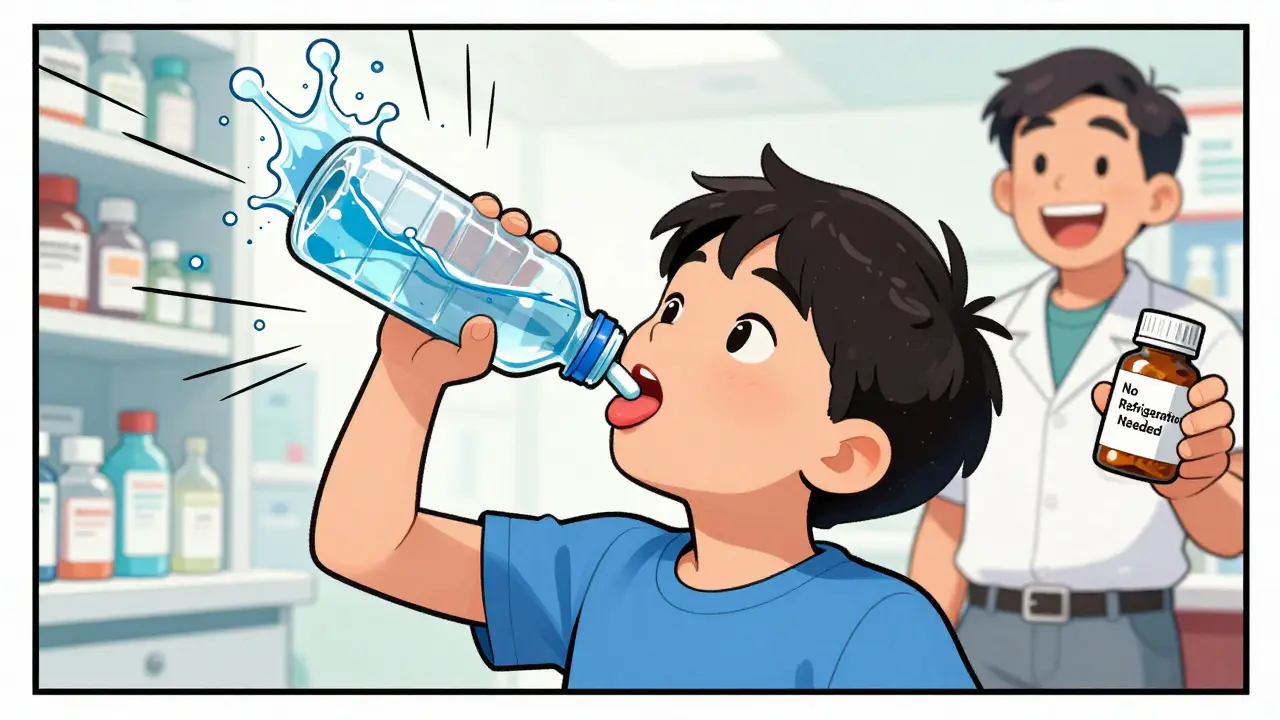
Start around age 3. Use mini-marshmallows or soft bread balls. Let them practice swallowing small, soft things. Then move to actual mini-tablets. Use the "pop-bottle method": have them take a sip of water from a bottle, place the tablet on their tongue, then swallow. It works 90% of the time - even for 3-year-olds.
A 2022 American Academy of Pediatrics report says kids as young as 4 can reliably swallow 2-4mm tablets. By age 6, they can handle regular-sized pills. And when parents are shown how to do it? Acceptance rates jump 65%.
Cost, Waste, and the Bigger Picture
Let’s talk numbers. In 2022, NHS England spent £19.6 billion on prescriptions. Pediatric meds made up a big chunk. A 2021 analysis found that substituting liquid prescriptions with tablets saved £7,842 per 10,000 prescriptions. That’s not just money - it’s less packaging, fewer refrigerated shipments, less expired medicine thrown out.
And it’s not just the UK. The FDA and EMA now actively encourage drug makers to develop solid forms for kids. Between 2008 and 2022, the EU approved 47 new pediatric tablets - and only 12 new liquid formulations. The trend is clear: the future of kids’ medicine is smaller, sturdier, and smarter.
But here’s the catch: 42% of pediatric meds still don’t have official dosing guidelines for tablets. That’s why some doctors stick to liquids - they’re not sure what to prescribe. It’s not laziness. It’s lack of info.
What Should You Do?
Here’s your practical guide:
- Under 6 months: Stick with liquid. No exceptions.
- 6 months to 2 years: Liquid is still common, but ask if a mini-tablet is available. Many now come in sprinkle form - you can mix them into applesauce.
- 2 to 4 years: Start training. Use soft practice pieces. Try mini-tablets with flavoring that actually tastes like fruit.
- 4+ years: Tablets are almost always a better option. They’re cheaper, more stable, and easier to give.
Ask your pharmacist: "Is there a tablet version?" Don’t assume liquid is the only choice. Ask about flavor - if it doesn’t taste real, ask for a different brand. And if your child is scared, don’t force it. Practice with marshmallows first. Make it a game.
The bottom line? The automatic choice for kids isn’t liquid anymore. It’s time to rethink what’s really best. For most kids, over age 2, the tablet wins - if you know how to use it.
Common Myths Debunked
- Myth: Crushing tablets is safe. Truth: Crushing can destroy timed-release coatings, change absorption, and make dosing inaccurate. Never crush unless instructed.
- Myth: Liquids are more accurate. Truth: Measurement errors happen in 15-20% of cases. Tablets give exact doses every time.
- Myth: Kids can’t swallow pills before age 5. Truth: With training, most 3-year-olds can swallow mini-tablets.
- Myth: Tablets are more expensive. Truth: Tablets cost 25-40% less per dose. They last longer. Less waste.
Can I crush my child’s tablet if they won’t swallow it?
No - unless your doctor or pharmacist specifically says it’s safe. Many tablets have special coatings that control how the medicine is released. Crushing them can cause the full dose to hit at once, leading to side effects or reduced effectiveness. Some tablets can be split, but never crush. Ask for a mini-tablet or liquid alternative instead.
Are liquid medications more effective than tablets?
Not necessarily. Liquids may absorb slightly faster - about 15-30% quicker for some drugs - but the difference rarely affects how well the medicine works. For most antibiotics, pain relievers, or allergy meds, tablets are just as effective. The real advantage of liquids is for very young infants or when precise, tiny doses are needed.
Why do some pharmacies only stock liquid versions?
It’s often because the manufacturer only makes it as a liquid - not because it’s better. Many older medications were designed decades ago when solid forms for kids weren’t a priority. But new formulations are being developed. Ask if there’s a generic tablet version. Some brands offer both. Also, some insurance plans only cover the liquid version, which can limit choices.
My child refuses to swallow tablets. What can I do?
Start with practice. Use small, soft items like mini-marshmallows or bread balls. Teach the "pop-bottle method": have your child take a sip of water from a bottle, place the tablet on their tongue, then swallow as they drink. Most kids learn this in a few days. Also, try flavored mini-tablets - ones that actually taste like fruit, not chemical candy. If it still doesn’t work, ask about sprinkle capsules or liquid alternatives.
Do liquid medications have more side effects?
Not directly. But liquids often contain more additives - sugars, preservatives, dyes - to improve taste and shelf life. These can cause upset stomachs or allergic reactions in sensitive kids. Tablets usually have fewer inactive ingredients. If your child gets a rash or stomach issues after a liquid, ask if a tablet version exists.



Donnie DeMarco
Man, I never thought about how much gross chemical-flavored syrup we’ve been force-feeding our kids for years. My 3-year-old used to scream like I was torturing him with the antibiotic stuff. Then we switched to these little fruit-flavored mini-tablets? Game changer. He asks for them now like they’re candy. No more midnight battles, no spilled bottles, no expired meds gathering dust. Why did no one tell us this sooner?
Tom Bolt
While I appreciate the sentiment, the article fails to adequately address pharmacokinetic variability between solid and liquid formulations. The bioavailability of certain antibiotics-such as amoxicillin-is demonstrably higher in liquid form due to gastric dissolution kinetics. To suggest tablets are universally superior is not only misleading but potentially dangerous in clinical contexts where precise absorption curves are critical.
Alexander Erb
As a pediatric nurse for 12 years, I’ve seen this shift firsthand. 🙌 The mini-tablets? Total game-changer. Kids don’t hate swallowing-they hate the taste and the mess. And honestly? Most parents just don’t know how to teach swallowing. I always tell them: start with mini-marshmallows, use the bottle trick, and make it a game. By age 3, 9 out of 10 kids get it. Also-no, crushing pills is NOT safe unless the label says so. I’ve seen kids get sick from crushed extended-release meds. 🚫
Denise Jordan
Yeah right. Next you’ll tell me we should let toddlers drink coffee and ride motorcycles. Liquids are the standard for a reason. Kids are kids. They’re not little adults. If you think a tablet is easier, you’ve never tried to convince a screaming toddler to swallow something they can’t see dissolving. I’m not buying it.
Miranda Varn-Harper
It is imperative to recognize that the normalization of solid dosage forms in pediatric populations represents a paradigmatic departure from established clinical best practices. The assertion that tablets are "better" for most children under the age of four is not substantiated by longitudinal, peer-reviewed pharmacovigilance data. Moreover, the anecdotal testimonials presented herein lack methodological rigor and constitute a form of confirmation bias.
Shourya Tanay
Interesting. From an Indian pediatric pharmacy standpoint, we see a similar trend, though access to mini-tablets remains limited outside urban centers. The real barrier isn't efficacy-it's supply chain. Most formularies still default to liquids because manufacturing infrastructure for pediatric solid dosages is underdeveloped. Also, cultural factors: many parents believe "liquid = stronger" due to traditional medicine associations. Education gap is massive.
LiV Beau
OMG YES!! I just switched my 5-year-old to mini-tablets last week and I’m crying happy tears 😭 We used to have to bribe him with ice cream after every dose. Now he just takes it like a champ and says "more please?" 🍓💊 I started with the bottle trick-100% worked. Also, the grape one actually tastes like grapes?? Wild. Tell your doctor to ask for the tablet version!!
Adam Kleinberg
They’re pushing tablets because Big Pharma wants to cut costs and get rid of those pesky refrigerated shipments. You think this is about kids? Nah. It’s about profit margins. And don’t even get me started on the "flavoring"-those are just sugar bombs with artificial dyes. They’re making kids addicted to sweet meds so they’ll keep coming back. Wake up people. This is a scam. The FDA doesn’t have your back.