
NMS Symptom Checker
This tool assesses the four key symptoms of Neuroleptic Malignant Syndrome (NMS) based on clinical guidelines. NMS is a life-threatening reaction to dopamine-blocking medications. If you or someone you know has these symptoms, seek emergency medical care immediately.
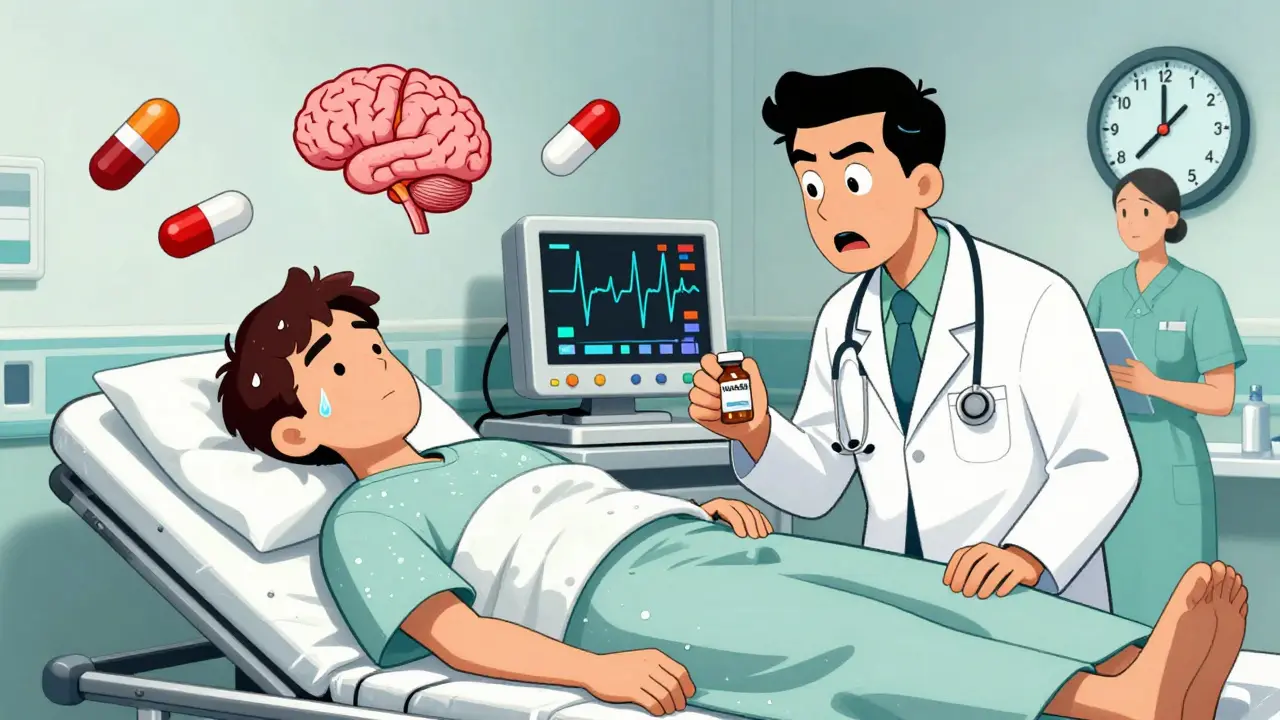
Neuroleptic Malignant Syndrome isn’t something most people hear about until it’s too late. It doesn’t show up in ads or public health campaigns. But if you or someone you know is taking an antipsychotic - whether for schizophrenia, bipolar disorder, or even severe nausea - this rare reaction can turn dangerous in hours. And if it’s missed, it can be fatal.
What Exactly Is Neuroleptic Malignant Syndrome?
Neuroleptic Malignant Syndrome, or NMS, is a severe, sometimes deadly reaction to medications that block dopamine in the brain. These include older antipsychotics like haloperidol and chlorpromazine, but also newer ones like risperidone and olanzapine. Even anti-nausea drugs like metoclopramide and promethazine can trigger it.
The core problem? Dopamine isn’t just about mood. It’s vital for movement, body temperature control, and muscle function. When these drugs block dopamine receptors - especially in the hypothalamus and basal ganglia - the body loses its ability to regulate itself. The result is a cascade of physical breakdowns that happen fast and hard.
It’s not common. Today, it affects about 0.01 to 0.02 percent of people on newer antipsychotics. But back in the 1980s, when first-generation drugs were the norm, rates were as high as 2 percent. That drop is thanks to better medications - but it hasn’t disappeared.
The Four Signs You Can’t Ignore
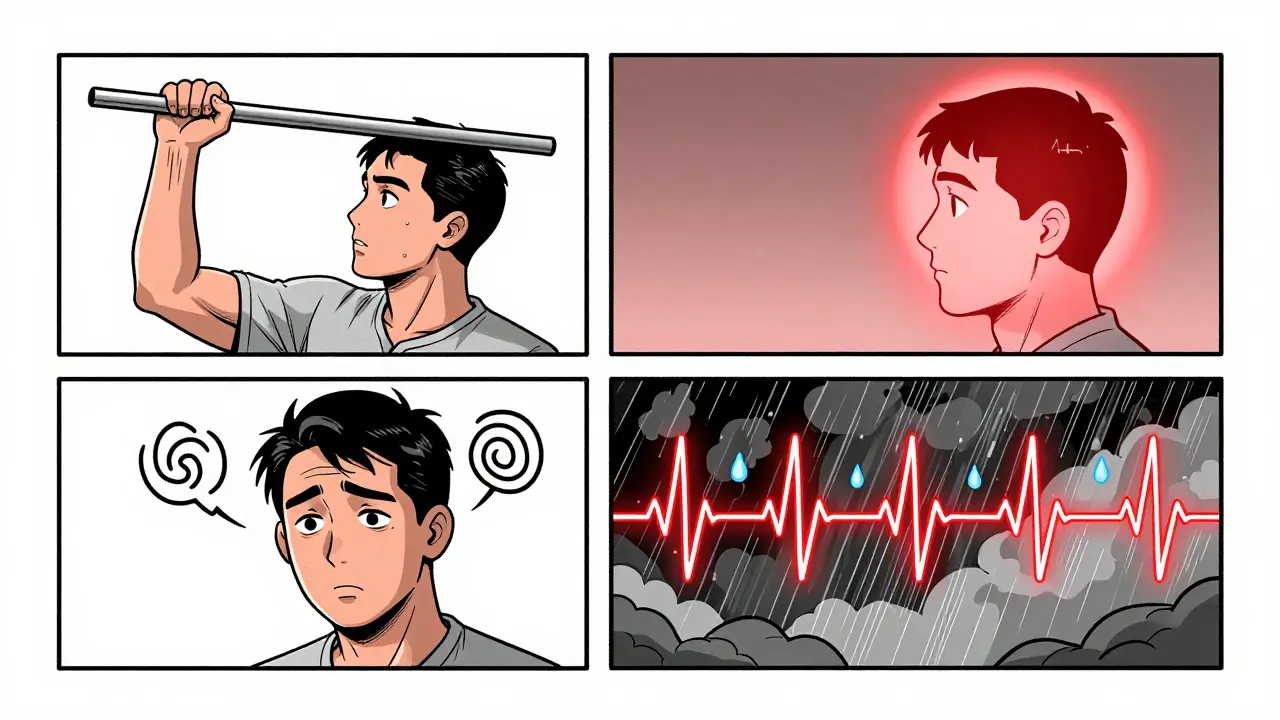
NMS doesn’t sneak up. It hits with a clear pattern - four key symptoms that usually appear together. Missing even one can delay life-saving treatment.
- Muscle rigidity: Not just stiff muscles. This is "lead pipe" rigidity - where limbs feel like they’re made of concrete. Even when a nurse tries to move your arm, it doesn’t bend. It resists evenly, like pushing against a steel bar.
- High fever: Temperature above 100.4°F (38°C), often spiking to 104°F or higher. This isn’t a typical fever from infection. It’s from muscles overheating due to constant contraction.
- Changed mental state: You might become confused, agitated, or unresponsive. Some people stop speaking. Others stare blankly. It’s not psychosis worsening - it’s the brain losing its grip on reality due to chemical disruption.
- Autonomic chaos: Your body’s automatic systems go haywire. Heart races (over 90 bpm), blood pressure swings up and down, you sweat heavily, and you breathe fast. These aren’t random. They’re signs your nervous system is failing to regulate basic functions.
These symptoms usually show up within the first two weeks of starting or increasing a medication. But they can also appear after months of stable use - or even after suddenly stopping a Parkinson’s drug.
Why It’s So Often Misdiagnosed
Emergency rooms and even psychiatric units miss NMS more than you’d think. About 12 to 30 percent of cases are initially labeled as "worsening psychosis," "infection," or "severe anxiety."
Why? Because the early signs look like psychiatric flare-ups: agitation, mutism, confusion. Doctors who don’t see the muscle rigidity or fever might just up the antipsychotic dose - making things far worse.
One patient on a mental health forum described being told, "You’re just having a bad episode," while their temperature climbed to 105.1°F and their muscles locked solid. It took 48 hours before anyone connected the dots.
Even when doctors suspect NMS, they might not know the lab markers. Creatine kinase (CK) levels often spike above 1,000 IU/L - sometimes over 100,000. That’s a sign your muscles are breaking down. That’s not normal. That’s rhabdomyolysis. And if it’s not caught, it can wreck your kidneys.
What Happens If You Don’t Act Fast
NMS kills. Without treatment, 10 to 20 percent of cases end in death. The main causes? Kidney failure from muscle breakdown, heart rhythm problems, or blood clots from immobility.
Even if you survive, recovery isn’t quick. Most people spend days to weeks in the ICU. Muscle damage can leave you weak for months. One survivor reported taking eight weeks to walk without help.
And then there’s the fear. About 65 percent of people who’ve had NMS are terrified to take antipsychotics again - even if they still need them for their mental health. That creates a terrible catch-22: treat the illness, or risk dying from the treatment.
How Doctors Treat It - And Why Time Matters
There’s no magic pill. Treatment is about stopping the cause and supporting the body while it recovers.
- Stop the medication: Right away. No exceptions. Even if the patient is unstable, the drug must be discontinued.
- Cool the body: Ice packs, cooling blankets, IV fluids - anything to bring the temperature down before organs start failing.
- Hydrate aggressively: At least 1 to 2 liters of IV fluids quickly, then 100-150 mL per hour. This flushes out muscle debris and protects the kidneys.
- Use dantrolene or bromocriptine: Dantrolene relaxes muscles and reduces heat production. Bromocriptine tricks the brain into thinking dopamine is still present, helping reset the system. Neither is a cure - but both can speed recovery.
- Monitor constantly: CK levels, kidney function, electrolytes, blood pressure, heart rhythm. Every 6 to 12 hours at first. If CK stays high or urine output drops below 30 mL/hour, dialysis might be needed.
Studies show that patients treated within 24 hours have a much better chance of survival. Delays beyond that increase complications dramatically.
Who’s Most at Risk?
NMS doesn’t pick favorites - but some people are more vulnerable:
- People on high-potency first-gen antipsychotics like haloperidol
- Those whose doses are increased too fast - especially by more than 5 mg/day of haloperidol
- Patients receiving injections instead of pills
- Those taking lithium or other drugs that increase dopamine blockade
- Younger males - men are about twice as likely to develop NMS as women
- People with mood disorders, especially bipolar disorder, rather than schizophrenia
And here’s something many don’t know: NMS can happen even with "therapeutic" doses - no overdose needed. About 12 percent of cases occur in people taking exactly what their doctor prescribed.
NMS vs. Serotonin Syndrome vs. Malignant Hyperthermia
These three conditions look similar - fever, muscle stiffness, confusion - but they’re not the same. Mixing them up can be deadly.
| Feature | Neuroleptic Malignant Syndrome (NMS) | Serotonin Syndrome | Malignant Hyperthermia |
|---|---|---|---|
| Onset | Days to 2 weeks | Hours | Minutes after anesthesia |
| Key Muscle Sign | Lead pipe rigidity | Clonus, hyperreflexia | Masseter spasm, rigid muscles |
| Trigger | Antipsychotics, antiemetics | SSRIs, SNRIs, MDMA | Anesthesia gases, succinylcholine |
| Core Mechanism | Dopamine blockade | Serotonin excess | Calcium overload in muscle |
| Temperature | Often >104°F | Usually <104°F | Rapid spike to 107°F+ |
| CK Levels | Very high (often >10,000 IU/L) | Mild to moderate rise | Extremely high |
| Primary Treatment | Stop drug, dantrolene, bromocriptine | Stop drug, cyproheptadine, benzodiazepines | Dantrolene, stop anesthesia |
Clonus - that involuntary twitching in the ankle or wrist - is a dead giveaway for serotonin syndrome. NMS doesn’t have it. Masseter spasm (jaw locking) is unique to malignant hyperthermia. NMS doesn’t cause that. Getting this right changes everything.
What Comes After Recovery?
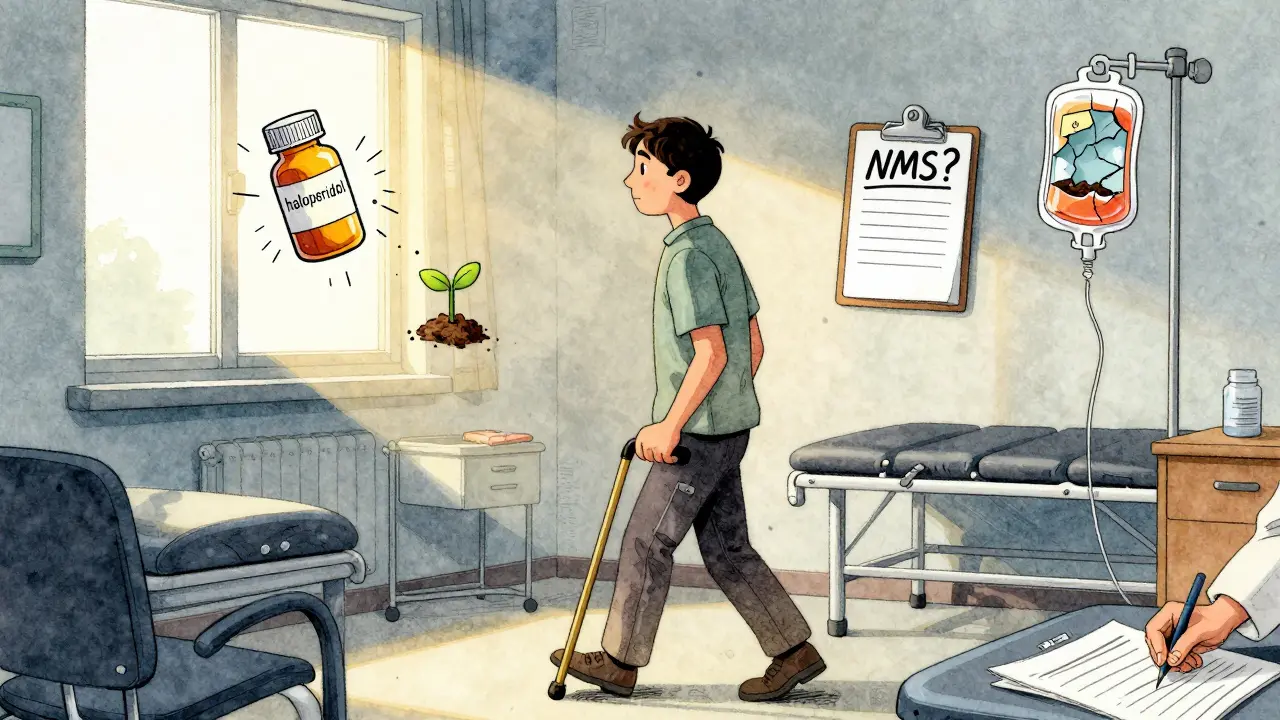
Surviving NMS doesn’t mean you’re out of the woods. Muscle weakness can linger for weeks. Some people need physical therapy. Others struggle with fatigue for months.
And the biggest question: Can you ever take antipsychotics again?
The answer? Sometimes - but with extreme caution. If a patient needs to restart, doctors usually wait at least two weeks after full recovery. They choose a low-dose, low-risk medication - like quetiapine or clozapine - and monitor closely. Some patients never take them again. That’s a personal, medical decision.
There’s hope on the horizon. Researchers are testing intranasal apomorphine, which can reverse NMS symptoms in under four hours. AI tools are being trained to flag early signs in electronic health records. And new drugs are being designed to treat psychosis without blocking dopamine so hard.
For now, awareness saves lives. If you’re on an antipsychotic and suddenly feel stiff, hot, confused, or your heart races - don’t wait. Tell your doctor. Say: "Could this be NMS?"
Frequently Asked Questions
Can NMS happen with antidepressants?
NMS is triggered by dopamine-blocking drugs, not antidepressants. But some antidepressants - like SSRIs - can cause serotonin syndrome, which looks similar. The two are different conditions with different treatments. Always tell your doctor what medications you’re taking.
Is NMS contagious or inherited?
No. NMS is not contagious, and there’s no proven genetic link. However, some people may have a higher sensitivity to dopamine-blocking drugs due to individual metabolism or other health conditions. It’s not something you inherit, but it can happen to anyone on the right medication.
How long does it take to recover from NMS?
Most people start improving within 7 to 10 days with proper treatment. But full recovery can take weeks to months. Muscle damage, fatigue, and weakness often linger. Some patients need rehab to regain strength. Recovery speed depends on how quickly treatment started and how severe the case was.
Can NMS come back after recovery?
Yes - but it’s rare. If someone gets NMS once, they’re at higher risk if they’re exposed to the same or similar drugs again. Most doctors avoid re-challenging with the same medication. If another antipsychotic is needed, it’s done with extreme caution, using low doses and close monitoring.
Are there any long-term effects after surviving NMS?
About 15 percent of survivors have lasting muscle weakness or movement issues at 30 days. Some report chronic fatigue or cognitive fog. Kidney damage is possible if rhabdomyolysis was severe. Most people recover fully, but the experience can leave lasting psychological effects - including fear of medications and anxiety about relapse.
What to Do If You Suspect NMS
If you’re on an antipsychotic and notice sudden muscle stiffness, fever, confusion, or a racing heart - don’t wait. Call your doctor immediately. If you can’t reach them, go to the emergency room. Say clearly: "I think I might have Neuroleptic Malignant Syndrome. I’m on [medication name]."
Bring a list of all your medications - including over-the-counter ones. Many cases are triggered by anti-nausea pills people don’t think of as dangerous.
Early action is everything. The sooner treatment starts, the better the chance of survival - and the less damage your body will take.


Katie Taylor
This is the kind of post that saves lives. If you're on an antipsychotic and feel stiff or hot, don't brush it off. Say something. Your life depends on it.
Georgia Brach
While the article presents NMS as a rare but underdiagnosed condition, it ignores the systemic issue: psychiatric medications are overprescribed as a chemical solution to social problems. The real crisis isn't NMS-it's the normalization of neurochemical control without consent or context.
Studies show that up to 40% of antipsychotic prescriptions are for off-label uses like insomnia or behavioral control in the elderly. NMS is a symptom of a larger pathology: the medicalization of human distress.
Why aren't we talking about trauma-informed care? Why isn't therapy funded like pharmaceuticals? The fact that this reaction is preventable by not prescribing these drugs in the first place is inconvenient for the industry.
The article's tone implies that we should accept these drugs as inevitable, when we should be demanding better. The real danger isn't NMS-it's the belief that we have no alternatives.
Payson Mattes
Okay but have you ever heard that NMS is actually a cover-up for mind control experiments? I know a guy whose cousin’s neighbor’s brother was hospitalized after taking risperidone-and then his medical records disappeared. The CDC doesn’t want you to know that some of these drugs were originally developed by the CIA in the 50s to induce dissociation. The rigidity? That’s not dopamine-it’s electromagnetic interference from smart meters. I’ve got the charts. You think they’d let you live if you knew the truth?
And why do all the cases happen in the US? Coincidence? Or is it because they’re testing population control on the mentally ill? Look at the stats-87% of NMS cases are in countries with privatized healthcare. That’s not random. That’s intentional.
Isaac Bonillo Alcaina
There is a fundamental flaw in your presentation of NMS: you conflate correlation with causation by attributing all cases to dopamine blockade alone. The literature clearly indicates that genetic polymorphisms in the DRD2 gene significantly increase susceptibility, yet you fail to mention this. Furthermore, the claim that ‘12 to 30 percent of cases are misdiagnosed’ is statistically misleading without citing the source. You cite a forum anecdote as evidence-this is not evidence, it’s anecdata.
Additionally, you state that ‘dantrolene or bromocriptine can speed recovery’-but neither is FDA-approved for NMS. Their use is off-label, and the evidence is based on case series, not RCTs. Your article reads like a Wikipedia summary masquerading as medical authority.
And why do you omit the fact that NMS incidence has dropped not because of better drugs, but because of stricter prescribing guidelines and reduced use of high-potency antipsychotics? The narrative you’ve constructed is dangerously simplistic.
Delilah Rose
I’ve been on olanzapine for six years now and never had an issue, but reading this made me realize how little I understood about what was actually happening in my body. I thought the stiffness I felt in the mornings was just from sleeping wrong. Turns out, it was probably early signs of muscle tension from the drug. I didn’t know dopamine controlled body temperature. I didn’t know muscle breakdown could fry your kidneys. I’m not scared-I’m just grateful someone took the time to explain this in plain language.
I’m going to print this out and give it to my sister who’s on haloperidol. She doesn’t trust doctors, but she trusts people who write clearly. This isn’t just medical info-it’s a lifeline for someone who’s been told they’re ‘just being dramatic’ when they feel off.
Also, I didn’t know metoclopramide could do this. I’ve been taking it for gastroparesis for years. I’m calling my GI doc tomorrow to ask if I should switch. I never thought a nausea pill could be this dangerous.
Thank you for writing this. Not because it’s perfect, but because it’s the kind of thing that makes people pause before scrolling past.
I’ve seen too many people dismissed as ‘difficult’ when they’re just trying to say their body is breaking down. This post gives them the words they need.
Bret Freeman
So let me get this straight-you’re telling me that a drug meant to calm my mind could turn my body into a furnace while I’m locked in a mental hospital with no one listening? And the doctors are too busy to notice I’m turning into a human toaster? This is insane. I’ve been on this stuff for three years and no one ever told me this could happen. I feel like I’m living in a horror movie where the monster is a prescription bottle.
My cousin’s kid had this. They thought he was having a psychotic break. He was screaming, his muscles were locked, and his temp was 106. They gave him more antipsychotics. He almost died. Now he’s on quetiapine and does fine. But the trauma? That never left.
I’m not mad at the doctors. I’m mad at the system that makes us take these pills without a full risk disclosure. You don’t get a warning label on your antidepressant that says ‘may cause your muscles to turn to concrete.’ That’s not a drug-it’s a gamble with your body.
I’m telling everyone I know. If you’re on an antipsychotic, read this. Print it. Tape it to your fridge. This isn’t fearmongering. This is survival.
niharika hardikar
Neuroleptic Malignant Syndrome (NMS) represents a pharmacodynamic cascade precipitated by D2 receptor antagonism within the nigrostriatal and hypothalamic pathways, resulting in dysregulation of thermoregulatory and neuromuscular homeostasis. The clinical triad of hyperthermia, rigidity, and autonomic instability is corroborated by elevated creatine kinase levels, indicative of rhabdomyolysis. Differential diagnosis must exclude serotonin syndrome, which presents with clonus and hyperreflexia, and malignant hyperthermia, which is triggered by volatile anesthetics and succinylcholine.
Current guidelines recommend immediate discontinuation of the offending agent, aggressive hydration, and pharmacologic intervention with dantrolene or bromocriptine, though evidence remains largely derived from retrospective case series. The absence of randomized controlled trials limits the strength of recommendation.
Further research is warranted into the genetic polymorphisms associated with NMS susceptibility, particularly within the CYP2D6 and DRD2 loci, which may enable predictive risk stratification in clinical practice.
Jillian Angus
I didn’t know any of this. I’ve been on risperidone for anxiety and never thought to ask what it was really doing. Just took it. Felt better. Didn’t think about the cost.
Now I’m wondering how many people just quietly suffer through this and never get help.
Diana Alime
OMG I JUST REALIZED MY MOM WAS PROBABLY HAVING NMS LAST YEAR AND THEY GAVE HER MORE DRUGS. SHE WAS SO STIFF AND HOT AND THEY SAID SHE WAS JUST "ACTING OUT." I’M SO MAD RIGHT NOW. I’M CALLING THE HOSPITAL TOMORROW. THIS POST IS A LIFE SAVER. THANK YOU.
Adarsh Dubey
Great breakdown. The comparison table between NMS, serotonin syndrome, and malignant hyperthermia is especially useful. I’ve seen clinicians confuse them before. The key is clonus for serotonin and lead-pipe rigidity for NMS. Simple, but easily missed.
One thing to add: NMS can also occur after abrupt withdrawal of dopamine agonists like levodopa in Parkinson’s patients. That’s often overlooked.
Bartholomew Henry Allen
Another example of American medical incompetence. In my country we don't let people take these dangerous drugs without full genetic screening. We don't wait for someone to nearly die to realize they're reacting. We prevent it. That's what real medicine looks like.
Dan Gaytan
This is so important. I’m so glad someone took the time to write this. I’ve been on clozapine for years and always worried about side effects. This helped me understand what to watch for. I’m sharing this with my support group. 💪❤️
Usha Sundar
My brother had this. Took 72 hours to diagnose. He’s fine now. But don’t wait. Say the words. NMS.