
Protein Distribution Calculator
Optimize Your Protein Timing
For medications like levodopa, distributing protein intake can significantly improve effectiveness. Research shows that 70% of your daily protein at dinner and 30% at breakfast/lunch may reduce "off" time by 2.5 hours per day for Parkinson's patients.
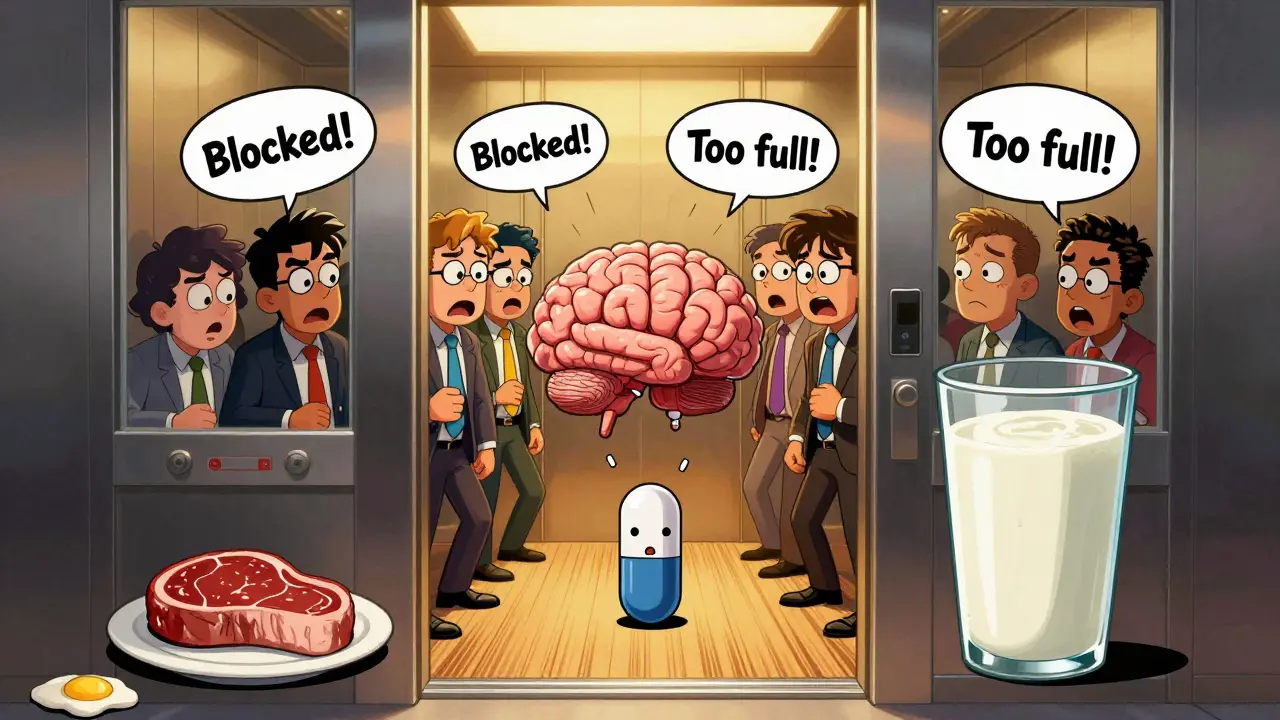
Why this works: Protein competes with medications like levodopa for transporters in the gut. Taking most protein at dinner allows medication to be absorbed before amino acids flood your system.
Note: For medications like levodopa, take your dose 30-60 minutes before protein-containing meals for best absorption. Always consult your doctor before making dietary changes.
Ever taken your medication with a steak and wondered why it didn’t seem to work? You’re not alone. For many people, especially those managing conditions like Parkinson’s disease, the protein in their meals can quietly sabotage how well their drugs work. It’s not about bad pills or wrong dosages-it’s about what’s on your plate.
Why Protein Interferes With Medication
Protein doesn’t just build muscle. It also floods your bloodstream with amino acids, and those amino acids compete with certain drugs for the same transport system in your gut and brain. Think of it like a crowded elevator: if there are too many people trying to get on at once, some get left behind. The most well-documented example is levodopa, a medication used to treat Parkinson’s disease that must cross the blood-brain barrier to work. This drug uses the same transporters as large neutral amino acids (LNAAs) found in meat, eggs, dairy, beans, and soy. When you eat a high-protein meal, those amino acids overload the system, and levodopa gets blocked. Studies show this can cut levodopa absorption by 30% to 50% in about 60% of patients. It’s not just levodopa. Some antibiotics like penicillins, certain antiepileptic drugs, and even thyroid medications can be affected. The Biopharmaceutics Classification System (BCS), a framework used by regulators and drug developers to predict how food affects drug absorption classifies drugs based on solubility and permeability. Drugs in BCS Class III-highly soluble but poorly absorbed-are the most vulnerable. Levodopa falls into this category, which is why it’s so sensitive to protein.How Protein Changes Your Body’s Drug Processing
Protein doesn’t just block transporters. It changes how your whole digestive system works. A high-protein meal slows down gastric emptying by 45 to 60 minutes compared to a low-protein one. That means your pill sits in your stomach longer before moving into the intestine where it’s absorbed. For some drugs, that delay doesn’t matter. For others, like those that need to hit peak levels quickly, it can mean the difference between symptom control and a bad day. At the same time, protein boosts blood flow to your intestines by 25% to 30%. That can actually help some drugs get absorbed better. This dual effect-blocking some, helping others-makes protein uniquely tricky. Unlike fat, which mostly just delays absorption, protein has a targeted, transporter-specific impact. That’s why two people taking the same drug can have completely different results depending on whether they had eggs for breakfast or a banana.What Medications Are Most Affected?
Not all drugs react the same way. Here are the most common ones impacted by protein:- Levodopa and carbidopa/levodopa combinations, used for Parkinson’s disease; bioavailability drops by 25% with just 50 grams of protein
- Penicillin antibiotics (like amoxicillin) - absorption can drop 15% to 20% with high-protein meals
- Carbidopa/levodopa enteral suspension (Duopa) - bypasses the stomach entirely, so protein doesn’t interfere
- Some antiepileptic drugs (e.g., gabapentin, phenytoin) - compete for the same amino acid transporters
- Levothyroxine - thyroid hormone replacement; protein can reduce absorption, especially if taken with soy or dairy
Drugs like statins, blood pressure pills, or most antidepressants are generally unaffected. That’s because they don’t rely on those specific amino acid transporters. But if you’re on a drug for Parkinson’s, epilepsy, or thyroid issues, your plate matters.

Real Solutions: Timing, Redistribution, and Tools
You don’t have to give up protein. You just need to manage it. Here’s what works:- Take medication 30 to 60 minutes before meals - especially if your meal has more than 15 grams of protein. This gives the drug a clear path before the amino acids arrive.
- Redistribute your protein - eat 70% of your daily protein at dinner and only 30% at breakfast and lunch. This strategy, backed by the Michael J. Fox Foundation, a leading organization in Parkinson’s research, has been shown to improve "on" time (when symptoms are controlled) by 2.5 hours per day.
- Use low-protein alternatives - regular bread has 5 grams of protein per slice. Low-protein bread has 2 grams. Same taste, less interference. Similar options exist for pasta, rice mixes, and even protein shakes.
- Use tracking apps - apps like ProteinTracker for PD, a mobile tool developed by Johns Hopkins for Parkinson’s patients help users log meals and medication times. Users report 40% fewer timing mistakes.
One Reddit user, u/ParkinsonsWarrior, shared that after switching to protein redistribution, their daily "off" time dropped from over five hours to just over two. They tracked it with a wearable sensor. That’s not luck-it’s science.
The Risks of Going Too Low
Some people try to fix the problem by cutting protein entirely. That’s dangerous. The Journal of Parkinson’s Disease, a peer-reviewed medical journal reported in 2024 that 23% of Parkinson’s patients on strict low-protein diets developed muscle wasting within 18 months. Protein isn’t just for drugs-it’s for your muscles, your immune system, your organs. The goal isn’t to eliminate protein. It’s to time it right. Experts recommend 0.8 to 1.0 grams of protein per kilogram of body weight per day. For a 70kg person, that’s about 56 to 70 grams total. Spread out smartly, it’s manageable.
Why Doctors Often Miss This
Surprisingly, many doctors don’t bring this up. The American Society for Nutrition, a professional organization for dietitians and nutrition scientists found in 2024 that 68% of clinicians never discuss protein timing with patients starting levodopa. The European Medicines Agency, the regulatory body for medicines in Europe noted in 2024 that 61% of drug labels give no protein-specific instructions-even when interactions are proven. Part of the problem is that protein’s effect is invisible. You don’t feel it. Your blood test looks normal. But your symptoms? They’re worse. That’s why working with a Parkinson’s-specialized dietitian, a healthcare professional trained in neurologic nutrition makes a huge difference. The Parkinson’s Foundation, a nonprofit organization focused on Parkinson’s disease care and research found that 78% of patients improved symptom control after just a few sessions with one.What’s Changing Now
The science is catching up. In 2025, the FDA, the U.S. federal agency responsible for public health regulation proposed new labels for drugs that show protein interactions-similar to alcohol warnings. Pharmaceutical companies now run food-effect studies in 92% of Phase III trials, up from 67% in 2020. New tools are emerging too. Duopa, a gel-based form of levodopa delivered directly into the small intestine, bypasses stomach absorption entirely. Since 2024, over 12,000 new users have started it annually. Time-restricted eating-limiting protein intake to a 6-hour window in the afternoon-showed a 32% improvement in levodopa efficacy in a 2025 study. Even gut bacteria may help: new research in Nature Medicine, a leading scientific journal for medical research found certain probiotics can reduce protein competition by 25%.What You Can Do Today
If you’re on a medication that might be affected:- Check your prescription label. Does it say "take on an empty stomach" or "avoid high-protein meals"?
- Track your meals and symptoms for a week. Note when you feel better or worse.
- Ask your doctor or pharmacist: "Could protein be affecting how this drug works?"
- If you have Parkinson’s or epilepsy, ask for a referral to a dietitian who specializes in neurological conditions.
- Try taking your pill 45 minutes before breakfast. See if your morning symptoms improve.
It’s not about perfection. It’s about awareness. One small change-like waiting 30 minutes after your pill before eating eggs-can make your whole day better.


Dylan Patrick
This is one of those things no one talks about until you're stuck in 'off' mode for hours. I took my levodopa with scrambled eggs for years. No wonder I felt like a zombie by noon. Switched to taking it 45 min before breakfast and now I can actually walk to the mailbox without falling over. Small change. Big difference.
Kandace Bennett
OMG I literally just learned this today 😱 I’ve been eating Greek yogurt with my meds since 2020. My poor dopamine receptors 😭 I’m switching to low-protein oatmeal tomorrow. Also, anyone else use ProteinTracker for PD? It’s a game-changer 🤖📈
Jinesh Jain
Interesting. In India, we often take medicines after meals because of stomach sensitivity. But this makes me rethink. Do you think this applies to ayurvedic herbs too? Like ashwagandha or shilajit?
tamilan Nadar
We have similar issues with thyroid meds here. People eat soy curry with levothyroxine and wonder why TSH is still high. No one teaches this in med school. Just sayin'
douglas martinez
Thank you for this comprehensive breakdown. The data on protein redistribution is particularly compelling. For patients managing chronic neurological conditions, nutritional timing is not a lifestyle choice-it’s a therapeutic intervention. I recommend all clinicians integrate this into their standard counseling protocols.
Byron Boror
So now we're telling people to eat like robots? Take your pills before breakfast, avoid protein until dinner, track every gram? This is why America’s healthcare system is broken. Just give me a pill that works. I don't need a nutritionist to tell me when to eat my steak.
Tim Schulz
Let me get this straight. The FDA is finally catching up... 20 years after patients have been suffering. 🤦♂️ Meanwhile, my doctor still says 'just take it with food.' Classic. Also, who designed the label? 'Avoid high-protein meals' - like that’s helpful. Should it say 'Don’t eat anything that has a face'?
Alex MC
I’ve been on levodopa for 8 years. The protein redistribution trick changed my life. I used to have 6 hours of off-time. Now it’s under 2. I eat my chicken at dinner, eggs for snack, and take my meds with apple slices. Simple. No fancy apps. Just common sense. 🙏